
From international experience and public service to leading IBS with a clear belief that education must prepare people to act, adapt and lead
A degree can take years to earn, while the knowledge behind it can change in a matter of months. Today, artificial intelligence is reshaping jobs, industries are adapting to digital transformation, and employers increasingly need people who can think through unfamiliar problems rather than simply recall what they have been taught.
This leaves business schools with a difficult responsibility: how do they prepare students for a professional world that may look very different by the time they graduate?
For International Business School (IBS), Bulgaria, the answer lies in keeping education closely connected to the world students are preparing to enter, while giving them the judgement, curiosity and adaptability to navigate what comes next. This philosophy is reflected in the institution’s approach to innovation, international education, business partnerships and the relationship between knowledge and practice.
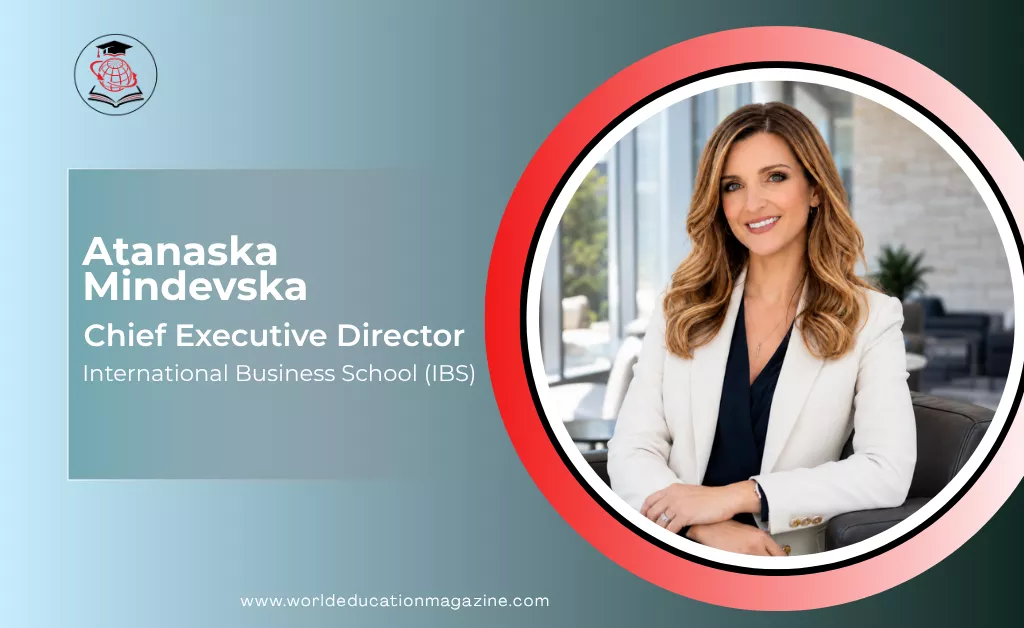
Under the leadership of Atanaska Mindevska, Chief Executive Officer of International Business School (IBS) in Bulgaria, the institution continues to bring these principles into its approach to business education.
A Career Across Worlds
Atanaska’s career has taken her through very different worlds: law, public institutions, international organisations, business and academia. Rather than following a single professional path, she has built her experience across environments where decisions carry different kinds of consequences, from public policy and energy to corporate strategy and institutional leadership.
Her years in New York City were an important part of that development. Her experience at Columbia University and within an international environment connected with the United Nations gave her exposure to a broader way of thinking about institutions, leadership and global affairs. She later brought that perspective into Bulgaria’s Ministry of Energy, before moving into the private sector, where she worked as an advisor and went on to hold senior executive positions, including Chief Administrative Officer.
Those experiences also formed the way she approaches leadership. Working across public institutions, international organisations and private companies taught her to look beyond individual decisions and consider how strategy, governance and people influence one another. For Atanaska, an idea only becomes meaningful when it can withstand scrutiny and translate into results.
That same approach extends to her academic work. She is currently completing her PhD in National Security, researching energy transition, institutional risk, resilience and investment decision-making. The subject is closely connected to the kind of leadership she practises: understanding complex systems, questioning assumptions, weighing evidence and making decisions with their longer-term consequences in mind.
It is this combination of international exposure, legal and institutional experience, business leadership and academic inquiry that she now brings to IBS. Her role, in her view, is not simply to manage an educational institution, but to strengthen the connections around it—to bring academia closer to business, Bulgaria closer to the world, technology closer to human potential, and students closer to opportunities that can shape what comes next.
That belief is also connected to IBS’s own history. From its earliest days, the institution has sought to connect education with the world beyond the classroom, making Atanaska’s vision less a departure from its identity than a continuation of it.
The Idea Behind IBS
In 1991, when IBS began as the Bulgarian-Danish School of Commerce, Export and Marketing, international cooperation was not a future ambition. It was already part of the institution’s foundation, bringing education, business and cross-border thinking together from the outset.
35 years later, the context has changed dramatically. The world students are preparing to enter is being reformed by technology, AI and rapidly evolving industries, making the distance between what is taught in a classroom and what happens in the workplace increasingly difficult to predict.
For IBS, that makes the purpose of education broader than passing on knowledge that already exists. Students need to learn how to work with uncertainty, see problems from different perspectives and turn what they learn into decisions and action.
That shift also brings the institution itself into the conversation: if the world of work keeps changing, how should education change with it?
Making Innovation Practical
For Atanaska, innovation at IBS begins long before a new programme appears on the curriculum. It begins with looking ahead and asking what students will actually need when they enter a business world that may look very different from the one institutions know today.
That way of thinking influences what IBS teaches, the cases students examine, the projects they take on and the practitioners they meet along the way. The introduction of programmes in areas such as artificial intelligence and digital management is part of that response to changing business realities, but for Atanaska, innovation goes deeper than adding new subjects to a curriculum.
It is also about changing the experience of learning itself. Students should not simply receive information and reproduce it in an examination; they should be encouraged to question what they are taught, test ideas, work with others and understand what happens when those ideas meet real situations.
In that sense, the classroom becomes less about preparing students for a fixed version of business and more about giving them the confidence and ability to navigate what comes next
Teaching for What Comes Next
In Atanaska’s view, the value of an academic programme is measured by what students can do with what they have learned. That belief has determined a broader shift at IBS: instead of starting with the traditional question, “What should we teach?”, the school increasingly asks, “What should our graduates be able to do?”
The difference may sound subtle, but it changes how education is designed.
It means looking beyond established curricula and paying closer attention to the industries, roles and professional realities students are preparing to enter. At IBS, this thinking has contributed to programmes such as Artificial Intelligence in Business, International Hospitality Management and Health Management, which brings academic education together with the expertise and practical experience of leading doctors and healthcare professionals in Bulgaria.
The same approach extends beyond the classroom. IBS is building stronger relationships with employers, including international organisations such as KPMG Audit and Adecco Bulgaria, creating opportunities for practical initiatives, expert interaction and a more direct exchange between academia and business.
For Atanaska, that exchange should not begin after a programme has already been designed. Universities, she believes, should involve business much earlier in the process, listening to what professional life demands before deciding what students need to learn. And as education increasingly crosses national and cultural boundaries, that conversation has to become broader still.
Learning Beyond One Perspective
According to Atanaska, international education is not simply about studying in another language or travelling abroad. It is about learning to look at the same problem from more than one perspective.
At IBS, international cooperation includes academic partnerships, mobility, joint educational and research initiatives, knowledge exchange and participation in wider academic networks. For students, that exposure develops intellectual flexibility.
Business decisions today rarely exist within one national context. A manager may work with teams in several countries, serve customers from different cultures and respond to events thousands of kilometres away.
When students encounter different perspectives during their education, they learn that there may be more than one intelligent answer to the same question. For Atanaska, that is an essential leadership skill. Creating those perspectives depends partly on the relationships an institution builds with other academic and professional organisations.
Partnerships With Purpose
A partnership can begin with a formal agreement, but for Atanaska, the signing is only the point at which the real work begins. What matters is what that agreement makes possible afterwards: students moving between countries, faculty sharing expertise, ideas crossing institutional boundaries and organisations finding practical ways to learn from one another.
“For us, a meaningful partnership begins with shared purpose rather than a signed document. We look for institutions and organisations that bring complementary expertise, international perspective and a genuine willingness to create opportunities together,” Atanaska explains.
That approach determines the way IBS builds its international relationships. Rather than measuring a partnership by the number of agreements on paper, the institution looks at what those relationships enable—student mobility, faculty exchange, joint educational and research initiatives, guest expertise, collaborative projects and engagement with business and society.
The emphasis is on creating experiences that connect education with the realities beyond the classroom. When students and faculty can move between institutions and countries, they gain exposure to different academic environments, professional perspectives and ways of thinking. Programmes such as Erasmus+ make that exchange tangible, turning international cooperation from an institutional commitment into something students and faculty can actually experience.
When Education Crosses Borders
For Atanaska, Erasmus+ represents something much larger than the opportunity to study or work abroad. At IBS, mobility is treated as part of the educational experience itself, creating opportunities for students, doctoral candidates, academic staff and administrative staff to learn through direct exposure to other academic, professional and cultural environments, including through Erasmus+ KA171.
The value of that experience begins to emerge when people return home. Students come back with greater independence and adaptability, while staff bring with them new approaches, practices and perspectives that can influence how they teach, work and collaborate. The experience changes more than where they have been; it can change how they see their own environment.
That, perhaps, is where Atanaska sees the deeper value of international mobility. Living and working alongside people from different cultures teaches individuals to listen differently, understand perspectives that may not resemble their own and find ways to work together despite those differences.
For her, these are not simply international experiences or desirable professional qualities. They are foundations for leadership in a world where collaboration increasingly crosses borders.
And that belief in learning through difference does not stop at international mobility. It extends to the environment in which IBS itself operates, where another kind of diversity is shaping how the institution thinks about education, business and its place in the wider community.
The Advantage of Sofia
Where a school is located can influence what students see around them every day. A city can become part of the classroom when its businesses, industries and changing economic conditions provide examples of the ideas students encounter academically.
Atanaska sees IBS’s location as an advantage because Sofia sits at the intersection of different economic, cultural and business realities.
Central and Eastern Europe offers an environment in which students can observe how industries evolve, how entrepreneurship grows, how digitalisation changes organisations and how companies operate within local realities and the wider European market.
Sofia adds another dimension through its dynamic business environment and connection to the region. IBS does not want students to view global business only from the traditional centres of the world economy.
Some of the strongest lessons in innovation, resilience and adaptation can come from markets that have experienced rapid change. The ambition is therefore to make Sofia part of the learning experience itself.
That connection with the real business environment also raises an important question about how closely classroom learning should reflect the problems organisations face outside the institution.
Shortening the Distance to Business
Atanaska often says that the distance between the classroom and the boardroom should be much shorter. That means inviting business into education rather than treating it as something students encounter only after graduation.
At IBS, this connection can take the form of business cases, project-based assignments, interaction with practitioners, internships, partnerships and programmes whose content reflects developments in real industries.
But it is a two-way relationship. Universities should listen to business, and business should also be challenged by universities.
Employers can tell IBS what problems they face today. Academia can help students understand why those problems exist, question existing solutions and imagine what comes next. For Atanaska, that is when education becomes truly valuable.
The need to understand what comes next becomes even more important as technology begins to change the nature of work itself.
Preparing Students for Change
A student entering the workforce today may encounter technologies, roles and ways of working that are difficult to predict from the present. Education therefore has to give people enough grounding to begin a career while leaving room for what they will need to learn later.
Atanaska believes IBS cannot responsibly tell students that what they learn today will be enough for the rest of their careers. It will not. This is why adaptability itself must become an educational outcome.
Students need technological competence and AI literacy, but technology alone is insufficient. The more powerful AI becomes, the more important human judgement becomes: asking the right question, evaluating information critically, understanding ethics, communicating clearly, collaborating with others and taking responsibility for decisions.
IBS is therefore not preparing students for one specific job title. The aim is to give them something more durable: the ability to learn, unlearn and learn again.
If that is achieved, graduates do not have to fear the next technological shift but can participate in shaping it, a long-term view that naturally raises a larger consideration of what IBS itself should contribute as it enters its next chapter.
The Next Chapter for IBS
The future of business education will demand more than keeping pace with change. Students need skills they can apply; employers need graduates who can contribute from the outset, faculty need meaningful connections with the world beyond academia, and institutions need the agility to respond when the world around them changes.
This is where Atanaska sees the role of IBS taking shape. She wants its education to remain international and agile without losing the human connection at its centre. Technology, in her view, should expand what education can do, not replace the people and relationships that make learning meaningful.
That belief also determines how she imagines the school itself: a place where students are known as individuals rather than numbers, where companies do more than recruit graduates and become partners in creating knowledge, where faculty remain curious about the world beyond academia, and where internationalisation is woven into everyday learning rather than treated as a separate activity.
It is a vision built on the belief that meaningful change rarely comes from one dramatic moment. As Vincent van Gogh wrote, “For the great doesn’t happen through impulse alone, and is a succession of little things that are brought together.” Atanaska sees education in much the same way. A conversation with a professor, an unfamiliar idea, a difficult assignment, a connection with a company or an opportunity to look beyond one’s own experience can each seem small in isolation, yet together they can change the direction of a person’s life.
That, ultimately, is how Atanaska measures the value of education. Not simply by what a graduate knows when leaving IBS, but by whether they leave with a clearer sense of what they can do with that knowledge.
For her, success is a graduate who leaves IBS thinking: “I know more than when I arrived, but, more importantly, I now know what I can do with what I know.”
And perhaps that is the real purpose of business education: not to prepare people for a world that already exists, but to give them the confidence, curiosity and judgement to help shape what comes next.
Editorial Authentication
The above article is completely human-written and has been editorially developed using information provided.