
What happens when a country earns global recognition for its technology talent, yet many graduates still enter the workforce unprepared for the complexity of modern careers? Around the world, employers continue to raise the same concern. Technical knowledge alone no longer guarantees success. The future belongs to people who can think critically, communicate clearly, adapt quickly, and solve problems that do not come with textbook answers.
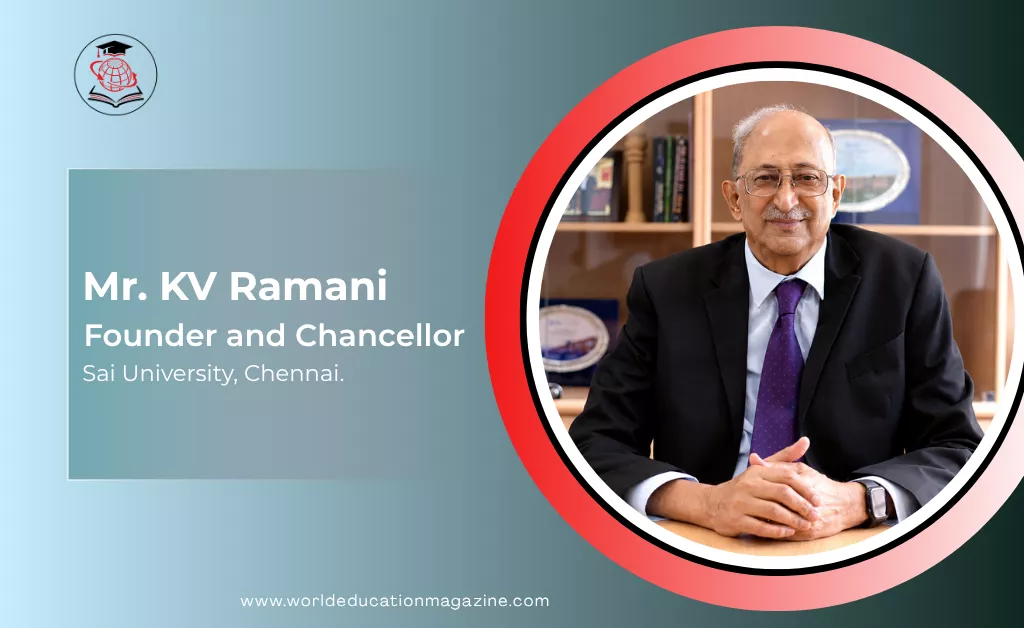
This question stayed with Mr. K.V. Ramani throughout a career that helped shape India’s technology story.
Over several decades, he contributed to India’s IT transformation through ventures such as Future Software, Hughes Software, institutions like NASSCOM, TiE Chennai, and several industry-building initiatives. From the early years of India’s rise as a technology powerhouse to its emergence as a global force, he witnessed firsthand how innovation transformed industries, created opportunities, and strengthened economies.
As he reflected on India’s future, he became convinced that higher education needed to evolve alongside the changing world. His experience in technology, together with years of philanthropic work in education, reinforced one belief: building an institution could create a deeper and more lasting impact than building another company.
That vision became Sai University.
Rather than creating another conventional university, Mr. Ramani set out with a mission to build a global institution that prepares students to succeed in a world defined by constant change.
For Mr. Ramani, education represents the next chapter of nation-building. If his earlier work helped place India on the global technology map, his focus today is helping prepare the next generation of innovators, leaders, and changemakers who will shape India’s future.
Building Beyond Individuals
Building an institution and building an organization are often treated as similar pursuits. Yet institutions endure because they are designed to outlast the people who create them. That distinction has shaped many of the decisions behind Sai University.
One of the most valuable lessons Mr. K.V. Ramani learned during his decades in the technology industry is that enduring institutions are built around a vision rather than individuals. Companies may rise under exceptional leaders, but institutions endure because they are grounded in values, strong systems, and a culture that continues to inspire excellence across generations. That belief became foundational to Sai University.
Sai University was established with the conviction that education should develop thoughtful individuals rather than simply deliver academic qualifications. Its multidisciplinary model encourages students to explore diverse fields, strengthen expertise in their chosen discipline, and apply knowledge through research, internships, innovation, entrepreneurship, and practical learning.
Mr. Ramani’s experience also reinforced the importance of collaboration. Some of the most meaningful breakthroughs emerge when people with different perspectives work together. That philosophy shapes the university’s academic environment, where students engage across disciplines and learn to approach complex challenges with broader insight.
More than preparing students for immediate career opportunities, Sai University was created as an institution capable of evolving with changing knowledge, technology, and society while remaining guided by its founding vision. Its purpose is to nurture graduates who continue learning, contribute responsibly, and create meaningful impact throughout their lives.
Education as a Generational Investment
Many successful careers eventually arrive at a question that extends beyond professional achievement. What kind of legacy will endure long after one’s direct involvement ends? For Mr. K.V. Ramani, the answer lay in building an institution that would continue shaping lives for generations.
Throughout his career, he helped build companies, industry associations, entrepreneurial ecosystems, and technology initiatives that contributed to India’s emergence as a global IT powerhouse. While those achievements were deeply fulfilling, they also convinced him that the country’s next phase of progress would depend on the strength of its higher education system.
His philanthropic work further reinforced this conviction. Through scholarships and educational initiatives, he witnessed how quality education could transform individuals, families, and communities. Those experiences strengthened his belief that establishing a world-class university would be one of the most meaningful ways to contribute to society. That vision gave rise to Sai University.
More than an educational institution, it represents a long-term commitment to nurturing innovators, entrepreneurs, researchers, policymakers, artists, and leaders equipped to address the complex challenges of a changing world. If Mr. Ramani’s earlier career contributed to strengthening India’s technology ecosystem, this chapter of his journey is dedicated to developing the people who will shape its future.
Purpose Before Profit
In higher education, an institution’s priorities become evident through the choices it makes. For Mr. K.V. Ramani, those choices have always been guided by a clear belief: education is a responsibility to society, not a commercial enterprise.
From its inception, Sai University was established as a not-for-profit institution with a philanthropic mission to place academic excellence, student development, and societal impact above financial gain. Every major decision is evaluated through its long-term contribution to the university’s educational mission rather than its immediate commercial value.
This philosophy is reflected in sustained investments in outstanding faculty, research, scholarships, academic innovation, student support, industry engagement, and infrastructure. These are viewed as investments in future generations rather than short-term expenditures.
Mr. Ramani’s entrepreneurial journey taught him that enduring institutions are built through patience, conviction, and consistency. That same perspective guides Sai University. The ambition has never been to become the largest university, but to build one recognised for academic excellence, integrity, and meaningful contribution to society.
Having received much from society throughout his career, Mr. Ramani sees Sai University as an opportunity to give back by creating an institution that will continue serving generations of students. Its greatest measure of success will be the quality of the lives it helps shape and the positive impact its graduates create.
Preparing for an Unknown Future
The question facing universities today is no longer how to prepare students for existing professions. It is how to prepare them for a future that is still taking shape. As industries evolve at an unprecedented pace, higher education must equip students with the ability to navigate change rather than simply respond to it.
At Sai University, this belief shapes the educational experience. Students are encouraged to explore knowledge across multiple disciplines while developing expertise in their chosen field. Learning extends beyond the classroom through research, internships, entrepreneurship, innovation, and community engagement, allowing students to apply ideas to real-world challenges.
Mr. K.V. Ramani hopes graduates leave the university with more than academic qualifications. He envisions individuals who are intellectually curious, ethically grounded, globally aware, and confident in making thoughtful decisions in an increasingly complex world. He also hopes they possess the courage to question conventional thinking, embrace new possibilities, and create meaningful solutions where none previously existed.
Traditional education systems often encourage students to specialize early and remain within narrow disciplinary boundaries. But technology and the world are changing very fast, and we do not even know what careers will exist, say 20–25 years from now. Therefore, it is not possible to build a curriculum for this emerging future.
In order to address this long-term issue, Sai University takes a different approach. Mr. Ramani believes that the most important challenges of the twenty-first century do not come neatly packaged within a single discipline. Solving them requires the ability to connect ideas across technology, business, science, humanities, law, public policy, and the arts.
That is why a truly multidisciplinary and liberal education environment has been built where students are encouraged to explore broadly while developing expertise in their chosen field to prepare for the unknown future.
Equally important is Sai University’s emphasis on experiential learning. Students are encouraged to engage with real-world problems through research, projects, internships, entrepreneurship, innovation labs, and community engagement. Learning should not be confined to classrooms or examinations. Students learn best when they are challenged to apply knowledge, question assumptions, and create solutions that make a tangible difference.
When a student graduates from Sai University, Mr. Ramani hopes they leave with much more than a degree. He wants them to be intellectually curious, technologically fluent, ethically grounded, globally aware, and confident in their ability to navigate uncertainty. He wants them to be effective communicators, critical thinkers, and compassionate leaders who understand that success is not only about personal achievement but also about creating positive impact for others.
Most importantly, he wants graduates to possess the courage to ask new questions, challenge conventional thinking, and pursue opportunities that may not yet exist. The jobs of the future, the industries of the future, and many of the solutions society will need in the future are still being imagined today. The responsibility of a university, in his view, is not simply to prepare students for the world as it is, but to empower them to shape the world as it is going to be in the future.
For him, the purpose of a university extends beyond preparing students for employment. It is to cultivate individuals capable of shaping the future through knowledge, responsibility, and purposeful leadership. That belief remains at the heart of Sai University’s educational philosophy.
Decisions Which Defined the Institution
Every institution is shaped by a handful of early decisions that define its character long before its reputation is established. Looking back, Mr. K.V. Ramani believes Sai University’s identity was formed by a few deliberate choices that continue to guide its direction.
The first objective was the decision to establish Sai University as a genuinely multidisciplinary institution rather than a narrowly focused professional college. Mr. Ramani believed the future would favour individuals who could connect ideas across disciplines and approach complex challenges from multiple perspectives.
The second was a commitment to experiential and research-driven learning. Instead of limiting education to classroom instruction and examinations, the university encourages students to engage in research, internships, innovation, entrepreneurship, and real-world problem-solving, allowing them to apply knowledge in meaningful ways.
The third was to build the university with a long-term institutional outlook rather than a commercial one. As a not-for-profit institution, Sai University has consistently prioritised academic quality, faculty, research, student development, and infrastructure, recognising that lasting excellence is achieved through sustained commitment rather than rapid expansion.
The fourth objective was to establish a truly International University from India, instead of merely adding to the long list of existing Indian Universities.
Several alternative paths were available. The university could have been established as a conventional engineering college, a business school, or another specialised institution. It could also have pursued faster growth by following commercially successful models already present in the market. Mr. Ramani deliberately chose a different direction.
Mr. Ramani’s years in the technology industry taught him that transformative institutions are created by anticipating future needs rather than replicating existing models. That conviction continues to shape Sai University’s vision for higher education.
Rethinking Technology Education
India’s technology story has evolved dramatically over the past few decades. The skills that once defined success have expanded beyond technical expertise to include adaptability, ethical judgment, creativity, and the ability to solve increasingly complex problems. Having witnessed this transformation firsthand, Mr. K.V. Ramani believes higher education must evolve alongside it.
One lesson has remained constant throughout his journey: technologies will continue to change, but the capacity to learn and reinvent oneself will always remain valuable. While programming languages, platforms, and tools evolve, the ability to think critically, embrace change, and keep learning enables individuals to remain relevant throughout their careers.
He also believes future technology leaders require a broader perspective. The next generation of technology leaders will also need to think far beyond technology. The most important challenges of our time, whether in healthcare, sustainability, finance, public policy, cybersecurity, or education, cannot be solved through technical knowledge alone. Many of the emerging challenges span multiple domains, making technical expertise most effective when combined with an understanding of business, public policy, ethics, economics, and human behaviour.
Another shift he has observed is the growing importance of entrepreneurship. India’s technology ecosystem has matured from delivering services to creating products, companies, and new industries. This transition calls for graduates who are willing to innovate, take calculated risks, and create opportunities rather than wait for them.
Equally important is ethical leadership. Technologies such as Artificial Intelligence, data analytics, biotechnology, and autonomous systems will profoundly influence society. Future leaders must understand not only what technology can do, but also what it should not do. They must be guided by strong values, social responsibility, and a commitment to using innovation for the greater good.
These perspectives have influenced Sai University’s approach to education. Sai University seeks to develop graduates who combine technical excellence with sound judgment, adaptability, and leadership, preparing them to contribute meaningfully in a rapidly evolving world.
Built for Constant Change
Universities face a unique challenge. By the time students graduate, many of today’s technologies will already have evolved. Preparing them for a single set of tools is therefore far less valuable than preparing them to adapt to continuous change. This understanding has shaped Sai University’s approach to education.
Mr. K.V. Ramani believes no institution can predict which technologies will define the next decade. What universities can do is equip students with the curiosity, confidence, and intellectual flexibility to navigate whatever comes next.
Artificial Intelligence, data science, biotechnology, robotics, cybersecurity, quantum technologies, and digital platforms are already transforming every sector of the economy. In such a world, technical proficiency remains essential, but it is no longer sufficient. Future professionals must be able to understand emerging technologies, adapt quickly, learn continuously, and apply knowledge creatively across different domains.
This philosophy has influenced the design of the university’s academic programs from the very beginning. Sai University has been built as a multidisciplinary institution where students are encouraged to combine expertise in technology with knowledge from business, economics, law, media, sciences, humanities, and public policy.
The most significant innovations of the future will occur at the intersection of disciplines, and students must be prepared to operate comfortably in those intersections. Students studying Artificial Intelligence, for example, must also understand ethics, communication, human behavior, regulation, and societal impact.
Likewise, future business leaders must understand the technological forces transforming their industries.
Equally important is Sai University’s emphasis on experiential learning. Students are encouraged to engage in research, innovation projects, internships, entrepreneurship initiatives, and industry collaborations from an early stage. Technology cannot be learned effectively through theory alone. Students must develop the confidence to experiment, build, test, fail, improve, and innovate. Through research-driven learning and practical exposure, they acquire the problem-solving mindset that will remain valuable regardless of how technology evolves.
This philosophy influences both the curriculum and the learning experience. Students are encouraged to study diverse subjects of their choice, apply knowledge through research, innovation, internships, entrepreneurship, and industry collaboration, developing the ability to solve unfamiliar problems rather than simply master existing ones.
Sai University also maintains a strong focus on emerging fields, including Artificial Intelligence, Automation, Climate challenges, Globalization, Bio Sciences, Media and Modern Law, while emphasising the importance of responsible innovation. As technology becomes increasingly powerful, sound judgment, ethical responsibility, and critical thinking become just as important as technical expertise.
For Mr. Ramani, the goal is not simply to prepare graduates for future careers, but to equip them with the mindset to keep learning, adapting, and contributing throughout their lives.
Unlocking India’s Full Potential
India’s rise as a global technology powerhouse has demonstrated the strength of its talent. The next challenge, Mr. K.V. Ramani believes, is creating an education system that enables this talent to become a source of innovation, research, and leadership.
Having witnessed India’s technological transformation firsthand, he believes the country now has an opportunity to move beyond producing skilled professionals and cultivate individuals capable of creating new ideas, businesses, and solutions with global impact.
Achieving this shift requires a broader approach to education. Students benefit from technical expertise, but they also need opportunities to explore ideas across disciplines, engage in research, solve real-world problems, and develop an entrepreneurial mindset. Universities should encourage curiosity, independent thinking, and the confidence to challenge conventional approaches.
Sai University was established with this vision. Its multidisciplinary model of education across all schools, combined with an emphasis on research, innovation, internships, and experiential learning, is designed to help students develop both competence and character while preparing them to contribute meaningfully to society.
For Mr. Ramani, India’s greatest strength has never been a shortage of talent. The real opportunity lies in creating an educational ecosystem that enables that talent to realise its full potential and contribute to the country’s next phase of growth and also contribute to the progress of the World.
Staying True to the Mission
The true character of an institution is revealed when financial pressures test its founding purpose. For Mr. K.V. Ramani, remaining faithful to that purpose requires discipline, patience, and an unwavering commitment to education as a public good.
When Sai University was established, the decision to operate as a not-for-profit institution reflected more than its legal structure. It affirmed a commitment to place students, academic quality, research, and long-term institutional development at the centre of every major decision.
Maintaining that commitment demands a long-term perspective. Universities often face pressure to expand rapidly or prioritise programmes with immediate commercial appeal. Mr. Ramani believes lasting reputation is built through academic excellence, sound governance, strong faculty, meaningful research, and the success of graduates over time.
His entrepreneurial experience reinforced this philosophy. While financial responsibility remains essential, an institution earns lasting respect by remaining true to its mission. At Sai University, that mission is to advance knowledge, nurture human potential, and contribute to society through education.
As Founder and Chancellor, Mr. Ramani sees his responsibility as safeguarding this vision for future generations. If Sai University is remembered for the integrity of its values, the quality of its graduates, and its contribution to society, he believes it will have fulfilled its purpose.
Leadership Reimagined
Leadership changes with experience. What begins as a pursuit of achievement gradually becomes a responsibility to build institutions, create opportunities, and enable others to succeed. For Mr. K.V. Ramani, that evolution has been shaped by decades across technology, entrepreneurship, philanthropy, and education.
Early in his career, leadership was closely associated with building organisations, overcoming challenges, and delivering results. Experience, however, broadened that perspective. Today, he views leadership as the responsibility to create environments where people and institutions can thrive long after the leader has stepped aside.
One lesson has remained constant throughout his journey: lasting impact is created through institutions that endure across generations. Leadership, therefore, is about building strong foundations, nurturing talent, and establishing values that continue to guide an organisation into the future.
He also believes leadership requires humility and a willingness to keep learning. In a rapidly changing world, no individual possesses every answer. Effective leaders remain curious, welcome diverse perspectives, and surround themselves with people whose strengths complement their own.
At this stage of his life, leadership is inseparable from purpose. Through Sai University, Mr. Ramani hopes to help develop thoughtful leaders, responsible citizens, pioneering researchers, entrepreneurs, and compassionate individuals whose work creates lasting value for society.
As he reflects on his journey, Mr. Ramani believes, “Leadership is not measured by what we accomplish for ourselves. It is measured by the opportunities we create for others, the institutions we strengthen, and the positive impact we leave behind for future generations.”
Lessons from Influences
No institution is built in isolation. Behind every founder’s vision are people and ideas that shape the way leadership, purpose, and institution-building are understood. For Mr. K.V. Ramani, those influences span globally respected universities, visionary business leaders, management thinkers, and spiritual teachings that have guided his journey over several decades.
Among his earliest influences were leading universities such as Harvard, Stanford, MIT, Caltech, Oxford, Cambridge, the University of London, the University of Paris, and the University of Tokyo. Visiting these renowned international institutions reinforced his belief that universities built around scholarship, research, and public service can contribute to society for centuries while remaining true to their founding purpose.
He also drew inspiration from J.R.D. Tata, whose commitment to integrity and nation-building demonstrated that enduring institutions are created by serving a purpose larger than commercial success.
Another leader he greatly respects and admires is N.R. Narayana Murthy. His role in building Infosys established a new benchmark for professionalism, corporate governance, transparency, and global competitiveness in India. What impressed Mr.Ramani most was Mr. Murthy’s emphasis on values-driven leadership and the belief that institutions must be stronger than any individual. That philosophy continues to resonate deeply with his own approach to institution building.
Another enduring influence has been Dr. A.P.J. Abdul Kalam. His vision of connecting science, education, and national development reinforced Mr. Ramani’s conviction that investing in young people is one of the most meaningful ways to shape a nation’s future. The writings of Peter Drucker also deepened his appreciation for purpose-driven leadership, strong values, and continuous learning as the foundations of enduring organisations.
Beyond business and education, Mr. Ramani credits his spiritual Guru, Shri Shirdi Sai Baba, as his deepest personal influence. The values of compassion, humility, service, and selfless contribution have shaped both his philanthropic work for the good of the society and his vision for Sai University.
Looking back, Mr. Ramani believes every influence, whether academic, professional, or spiritual, reinforced one enduring lesson: institutions should be built to serve future generations. That belief continues to guide his aspiration for Sai University as a place where knowledge, character, and purpose come together to create lasting value for society.
The 10-Year Vision
Most university leaders measure success through growth, rankings, and expansion. Mr.K.V. Ramani views the future differently. For him, a university’s greatest achievement lies in the influence it has on people, ideas, and society.
Looking ahead, he hopes Sai University will be recognised as one of India’s leading multidisciplinary institutions, respected for academic excellence, intellectual freedom, innovation, ethical leadership, and meaningful societal contribution. His vision is to attract outstanding students, faculty, researchers, entrepreneurs, and thought leaders from India and around the world.
He also envisions a strong culture of research and discovery, where faculty and students work together to address challenges in areas such as Artificial Intelligence, sustainability, healthcare, public policy, and other emerging fields. At the same time, he believes technological progress must remain guided by ethics and human values.
Innovation and entrepreneurship form another important part of this vision. Mr. Ramani hopes Sai University becomes a place where graduates create new ideas, enterprises, and solutions that generate lasting value for society. He also seeks stronger collaborations with leading universities, research institutions, and industry partners, giving students greater opportunities for global learning and research.
Ultimately, however, he believes the university’s greatest legacy will be reflected in its graduates. If they are recognised for their curiosity, leadership, adaptability, integrity and commitment to serving society, Sai University will have fulfilled its purpose. More than building a successful institution, his aspiration is to create a place where young people discover their potential and develop the confidence to envision and shape a better future.
Reviving India’s Knowledge Legacy
Discussions about higher education often focus on what universities can offer students. Mr. K.V. Ramani views their role more broadly. He believes universities should generate knowledge, contribute to national development, and help address challenges that extend beyond their campuses.
At the global level, Mr. Ramani sees India playing a greater role in shaping the future of higher education. As international collaboration continues to grow, he hopes Sai University will build meaningful partnerships with institutions across the world, creating opportunities for shared research, academic exchange, and innovation.
Drawing inspiration from India’s long tradition of scholarship, he hopes Sai University can contribute to restoring the country’s reputation as a global centre of learning. His vision is to build an institution that combines academic excellence, research, innovation, and ethical leadership while demonstrating how multidisciplinary education across multiple networked institutions, can respond to the complex challenges of the modern world, creating an Intellectual Capital of the World.
He also believes universities should move beyond transmitting existing knowledge. They should encourage students and faculty to pursue research, question assumptions, and contribute new ideas that advance society. Strengthening a culture of undergraduate research and innovation remains an important part of Sai University’s long-term mission.
Ultimately, he believes a university’s greatest contribution lies in the people it develops. When Sai University accomplishes to nurture graduates who combine knowledge with integrity, responsibility, and a commitment to improving the lives of others, it will have fulfilled the purpose for which it was established.
A Message to Higher Education Leaders Worldwide
Higher education stands at a defining moment. Rapid advances in technology, shifting workforce expectations, and increasingly complex global challenges are transforming what students need from a university.
Mr. K.V. Ramani believes these changes call for a Global Network of Institutions that are willing to cooperate and rethink how education is designed and delivered.
Mr. K. V. Ramani strongly believes that there is an urgent need to create a network of multiple institutions from around the world, leveraging the expertise of each institution and the student must be able to enrol in more than one institution simultaneously using technology, learn from the experts in each field from the best institutions, and achieve their academic goals from multiple universities concurrently, leading to a multi university education framework.
For him, the future of higher education lies in preparing students for lives of continuous learning, responsible leadership, and meaningful contribution. Universities must create environments where intellectual curiosity, creativity, ethical judgment, and collaboration are valued as highly as academic achievement.
Reflecting on his own journey, he believes technology has the power to transform industries, but education has the power to transform people. Institutions that remain committed to unlocking human potential will continue to serve society, regardless of how the world changes.
He also believes students should remain at the centre of every educational decision. This requires greater flexibility in learning, stronger opportunities for research and interdisciplinary collaboration, and the freedom for every student to discover and develop their individual strengths, from multiple networked institutions.
For policymakers, Mr. Ramani emphasises the importance of giving universities the autonomy to innovate while maintaining high standards of academic quality and accountability. Progress depends on institutions having the freedom to experiment with new approaches to teaching, research, assessment, and collaboration.
Projecting forward, Mr. Ramani also envisions creating a Global Education Network (GEN) that brings together multiple universities around the world to cooperate in simultaneous international learning, collaborate in research, faculty and student exchanges, create a global degree framework, experience in international work and living practices, to create global intellectual capital for the future interconnected world. By fostering partnerships across institutions and countries, he hopes to strengthen global knowledge-sharing and prepare future generations of Global Citizens for this emerging interconnected world.
Mr. K.V. Ramani can be contacted at: chancellor@saiuniversity.edu.in