
For more than a century, the United States has remained a leading destination for international students and global talent, creating a dynamic ecosystem of research, innovation, and entrepreneurship.
Despite recent shifts in global student mobility, college campuses continue to serve as crossroads where students from different cultures, languages, and lived experiences come together. This international exchange enriches campus life and strengthens the nation’s scientific, economic, and intellectual competitiveness.
Yet such diversity alone does not automatically create meaningful cross-cultural understanding. Higher education institutions today face a deeper challenge: preparing students for a world shaped by migration, technological transformation, and growing global interconnectedness.
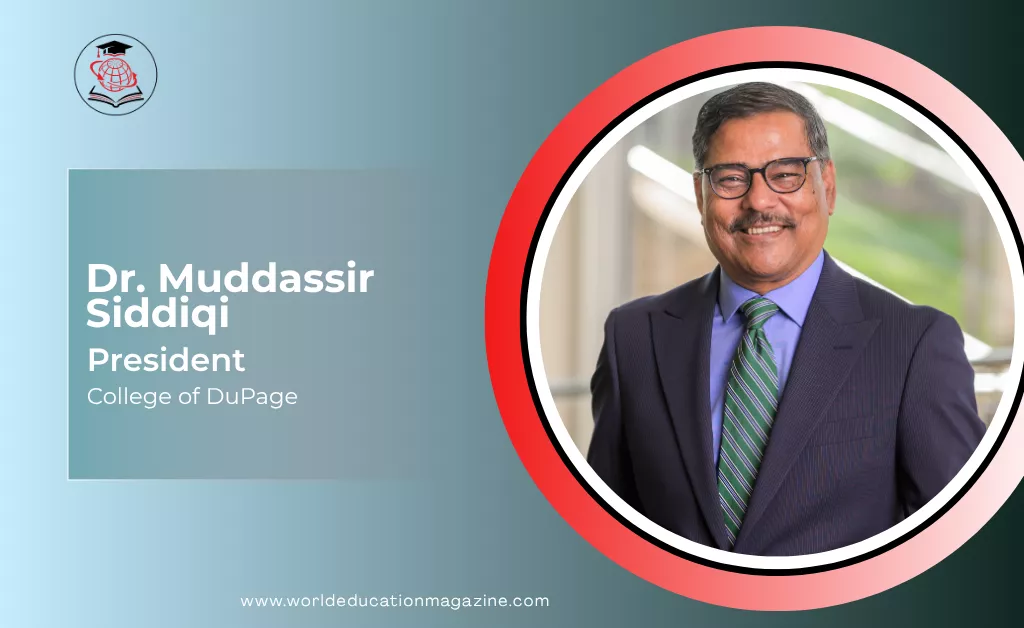
For Dr. Muddassir Siddiqi, President of College of DuPage, education represents far more than academic instruction or workforce preparation. He believes higher education carries a broader responsibility to help students understand people, cultures, and perspectives beyond their own experiences while preparing them to engage thoughtfully across cultures and societies.
This philosophy has shaped his leadership throughout a career defined by international experience, multicultural understanding, and a deep commitment to expanding educational opportunity.
From South Asia to American Higher Education
Raised in Pakistan within a family whose roots extend across both Pakistan and India, Dr. Siddiqi grew up surrounded by the historical and cultural complexities that continue to shape South Asia. Long before he entered higher education leadership, these experiences shaped his understanding of identity, belonging, coexistence, and the human dimensions of culture.
Living and working across multiple countries further broadened his perspective and reinforced his belief in education’s ability to foster understanding across differences. As an
immigrant, scholar, and higher education leader in the United States, Dr. Siddiqi approaches equity and inclusion through lived experience rather than institutional rhetoric alone.
Navigating different cultures, educational systems, and professional environments deepened his appreciation for intercultural dialogue, cultural humility, and relationship building across cultures.
“Education has the power to help people better understand one another.” Dr. Siddiqi reflects. “When students encounter different cultures and perspectives, they often begin to see both the world and themselves in new ways.”
Leadership Across Borders
Before entering higher education leadership in the United States, Dr. Siddiqi’s career unfolded across multiple industries, countries, and professional environments. His early career in manufacturing engineering allowed him to work with global organizations and observe firsthand how technological advancement, talent development, and operational excellence contribute to economic and social progress.
Working internationally also exposed him to different organizational cultures, economic systems, and approaches to innovation and institutional development. These experiences reinforced his belief that effective organizations consistently invest in people, adaptability, and lifelong learning.
“One of the most important lessons I learned is that meaningful progress often happens when people with different perspectives work together toward shared goals.” he says.
His international experiences further strengthened his belief that education remains one of society’s most powerful pathways toward mobility, opportunity, and personal growth. Whether in developing economies or advanced industrial societies, he witnessed education’s transformative influence on individuals, families, and communities.
Today, those experiences continue to shape his leadership philosophy and his broader understanding of higher education’s role in preparing students to thrive in a globally connected world.
Leadership Rooted in Human Potential
For Dr. Siddiqi, leadership extends beyond administration or operational management. He views leadership as the responsibility to create environments where students, faculty, and staff can thrive intellectually, professionally, and personally.
His transition from corporate manufacturing into higher education in 2005 brought together two important perspectives. He carried with him an industry mindset grounded in innovation, accountability, continuous improvement, and professional preparation. At the same time, his international and multicultural experiences deepened his commitment to student access, equity, and educational opportunity.
“Higher education should prepare students for more than employment,” Dr. Siddiqi says. “Colleges and universities also help shape ethical leaders, engaged citizens, and thoughtful
individuals who can contribute meaningfully to society.”
He believes effective leadership requires listening, adaptability, collaboration, and the ability to connect institutional strategy with the lived realities of students and communities. At the center of his leadership philosophy is a belief that education expands human potential, creates opportunity, and strengthens society.
Preparing Students for Education Beyond Borders
Higher education institutions today are preparing students for a world shaped by artificial intelligence, technological change, and global interconnectedness. Dr. Siddiqi believes community colleges play an especially important role in this environment because they serve diverse student populations seeking educational opportunity, economic mobility, university transfer pathways, and lifelong learning.
At College of DuPage, his vision centers on creating a student-focused institution that prepares learners for success in a rapidly changing world. He believes students need more than academic knowledge alone. They also require adaptability, technological fluency, intercultural understanding, and strong critical thinking skills.
Under his leadership, College of DuPage continues to expand experiential learning opportunities, strengthen industry partnerships, and increase student access to globally informed educational experiences.
The college has also invested intentionally in international learning through its Field Studies and Study Abroad programs, which integrate classroom instruction with faculty-led domestic and international experiences. These opportunities include short-term field studies, semester-long immersion programs, and globally focused campus initiatives designed to broaden students’ understanding beyond traditional classrooms.
For Dr. Siddiqi, colleges and universities serve as bridges between local communities and the broader world.
Expanding Access to Education Beyond Borders
For Dr. Siddiqi, education beyond borders is not simply about travel. It is about helping students better understand people, cultures, and their place within the world.
Community colleges serve highly diverse student populations, including first-generation students, working adults, immigrant students, and students from historically underserved backgrounds. For many students, study abroad experiences become transformative opportunities that expand their confidence, broaden their perspectives, and shape their future aspirations.
College of DuPage was recently recognized by the U.S. Department of State as a top producer of Benjamin A. Gilman International Scholarship recipients and was also ranked first nationally among community colleges for sending students abroad during the 2023–2024 academic year. Dr. Siddiqi views this recognition as evidence that international education should not remain limited to highly selective institutions.
“Global learning should be accessible to all students, not just a privileged few,” he says. “Community colleges have a unique opportunity to expand access to experiences that can profoundly shape students’ lives.”
He also recognizes that many community college students come from underserved, low-income, and first-generation backgrounds while balancing employment, financial pressures, and family responsibilities. Without institutional support, many of these students may never have access to the global and cross-cultural experiences often available to more economically advantaged peers.
To address these barriers, College of DuPage works intentionally to support student participation in global learning through scholarships, financial aid guidance, and flexible program formats that accommodate diverse personal and financial circumstances.
For Dr. Siddiqi, education beyond borders is not simply about travel. It is about helping students better understand people, cultures, and their place within the world.
Learning Beyond the Classroom
Dr. Siddiqi believes some of the most meaningful educational transformations cannot always be measured through grades or transcripts alone. They often emerge through increased confidence, stronger communication skills, broader aspirations, and greater self-awareness.
He has seen students return from study abroad experiences with renewed ambition and a stronger sense of possibility. Some students who had never traveled beyond their local communities later pursued advanced degrees, leadership opportunities, international careers, or public service after participating in global learning programs.
For many community college students, these experiences represent their first opportunity to engage directly with different cultures and environments outside the United States.
Study abroad and experiential learning programs also help students develop resilience, adaptability, intercultural communication skills, and the ability to navigate unfamiliar environments thoughtfully and respectfully. These competencies have become increasingly valuable within both professional and civic life.
Many College of DuPage programs integrate experiential and community-based learning into their structure, allowing students to engage directly with cultures, environments, and social issues beyond traditional classrooms.
“These experiences often help students discover strengths and possibilities they did not previously see in themselves,” Dr. Siddiqi says.
Leading Through Change and Innovation
Leadership in higher education today requires navigating technological disruption, changing workforce expectations, demographic shifts, mental health concerns, and growing demands for access and inclusion. Dr. Siddiqi believes effective leadership in this environment requires balancing innovation with humanity while remaining deeply committed to student success.
He believes institutions need leaders who think strategically, demonstrate cultural intelligence, act ethically, and remain responsive to the evolving realities facing students and communities. For Dr. Siddiqi, impactful leadership is ultimately measured by the opportunities institutions create for students, particularly those who may face barriers to access and advancement.
Looking Forward
As College of DuPage continues evolving, the institution is strengthening academic programs, professional education, student support services, and experiential learning opportunities in response to changing educational and economic realities. The college is expanding offerings in areas such as artificial intelligence, healthcare, advanced manufacturing, and technology-enabled learning while also strengthening transfer pathways and international education initiatives.
Dr. Siddiqi remains motivated by the belief that education possesses the power to transform lives, families, and communities. Throughout his career, particularly in diverse educational environments such as Chicago and Houston, he has witnessed students overcome barriers through perseverance, support, and opportunity.
He believes talent and potential are widely distributed, even when opportunity is not.
“Education at its best does more than prepare students for employment,” Dr. Siddiqi says. “It helps people understand cultures, communities, and possibilities beyond the boundaries of their own experience.”
For Dr. Siddiqi, the future of higher education will depend on institutions capable of combining academic excellence with accessibility, innovation with humanity, and local engagement with global understanding. His vision centers on creating learning environments that prepare students to navigate complexity, contribute meaningfully to society, and succeed in an increasingly interconnected world.