
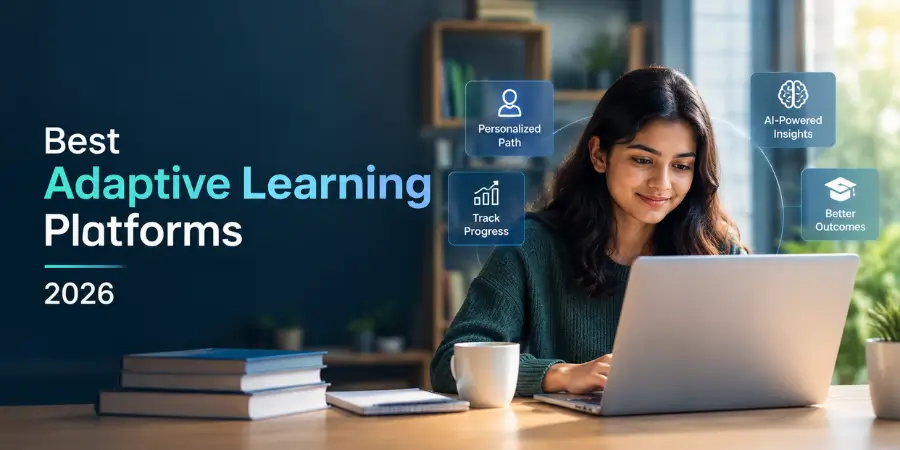
Every classroom and training team now faces the same problem. Learners arrive at different levels, move at different speeds, and lose interest when content doesn’t match either one. Adaptive learning platforms exist to fix that gap, and 2026 has brought a sharper, more competitive field of tools than ever before.
This guide ranks the five platforms worth evaluating this year, breaks down who each one fits best, and answers the questions people actually type into search bars before they buy.
What is a personalized adaptive learning platform?
A personalized adaptive learning platform is software that uses AI and real-time performance data to adjust the difficulty, pace, and sequence of lessons for each individual learner, rather than delivering the same fixed curriculum to everyone.
Instead of assigning one worksheet to a full class or one training module to an entire team, these systems track how a learner answers questions, where they hesitate, and which concepts they master quickly. The platform then reroutes the learner toward material that matches their actual skill level. Some tools focus on K-8 math. Others cover higher education, corporate compliance training, or workforce upskilling.
Which is the best adaptive learning platform for 2026?
Selecting one single best learning platform that suits every learner’s needs is impossible. When it comes to K-8 math, DreamBox Learning has an edge. For the development of rigor STEM capabilities, ALEKS is the one to beat. Knewton Alta is the leading platform for college-level courseware. Squirrel AI is the top player in big-scale personalization by way of fine-grained knowledge mapping. Century Tech is the major platform in the UK for monitoring both cognitive load and engagement.
The right choice depends on the age group, subject area, and whether the buyer is a school district, a university, or a corporate training department. The comparison below breaks down where each platform fits.
| Platform | Best For | Core Strength | Notable Limitation |
| DreamBox Learning | K-8 math and reading | Adjusts both difficulty and problem-solving strategy in real time | Can run expensive at district scale |
| ALEKS | High school and college STEM | Knowledge Space Theory maps exact gaps before advancing | Minimal gamification, which can reduce engagement for younger learners |
| Knewton Alta | Higher education courseware | Adaptive assignments built directly into existing course materials | Requires instructor buy-in to configure well |
| Squirrel AI | Large-scale personalized tutoring | Breaks subjects into thousands of micro knowledge points | Primarily built around the Chinese education market, with more limited global support |
| Century Tech | UK schools and cognitive tracking | Monitors engagement and mental fatigue alongside mastery | Best suited to UK curriculum standards |
Which adaptive learning platform works best for K-8 math?
DreamBox Learning is the strongest choice for K-8 math and early reading, because it adapts not just the difficulty of a problem but the strategy a student uses to solve it.
The platform builds a colorful, game-like environment that keeps younger learners engaged while logging every click and hesitation. If a student solves a problem the “hard way,” DreamBox nudges them toward a more efficient strategy on the next attempt, rather than simply making the numbers bigger. Teachers get dashboards showing exactly where a class is stalling, which makes small-group instruction easier to plan.
Schools that want a rigorous, mastery-first approach with less gamification tend to prefer ALEKS instead.
Which platform is best for rigorous STEM mastery?
ALEKS excels mostly in STEM subjects where real understanding must be achieved before new learning is introduced. It is grounded on Knowledge Space Theory and thereby, accurately depicts a student’s level of comprehension and restricts progress till the student has fully understood all the pre-requisites.
ALEKS, built by McGraw-Hill, covers math, chemistry, statistics, and business courses. It opens with a diagnostic assessment, then builds an individualized path through only the topics a learner hasn’t mastered yet, skipping material they already know. That precision makes it a common pick for summer credit-recovery programs and college placement courses, where compressed timelines demand efficiency over engagement features.
The tradeoff is tone. ALEKS looks and feels utilitarian, and some younger students find the lack of game mechanics harder to stay motivated through.
Which platform fits higher education best?
Knewton Alta, now part of Wiley, fits higher education best because it builds adaptive assignments directly into existing course materials rather than replacing the syllabus with a separate app.
Instructors keep their own textbook, lecture structure, and assessments, while Knewton Alta layers adaptive practice questions on top. As students answer, the system adjusts what appears next, closing gaps before an exam rather than after one. Universities use it heavily in introductory STEM courses, where large enrollment makes individual tutoring impractical.
The catch is setup time. Faculty need to configure the adaptive layer to match their course, and results depend heavily on how well that configuration is done.
Which platform scales personalization across large learner populations?
Squirrel AI scales personalization furthest by dividing every subject into thousands of narrow knowledge points, then using AI to pinpoint and target the exact gap a learner has, rather than adapting at the level of a broader topic.
This granularity lets Squirrel AI adjust content down to a single sub-skill, and the system can flag likely future struggles before a student encounters them. It has been deployed at significant scale, largely across the Chinese education market, and represents one of the more data-intensive approaches to adaptive learning available today.
Institutions outside that market should confirm language support and regional availability before committing, since the platform’s deepest integrations remain concentrated there.
Which platform tracks student engagement, not just accuracy?
Century Tech stands out for tracking cognitive load and engagement alongside academic performance, using an AI engine that recommends short lessons based on how tired or distracted a student appears to be, not just how many questions they got right.
Built for UK schools, Century Tech monitors fatigue signals during a session and re-sequences material when it detects a learner is struggling to focus, rather than pushing them through a fixed lesson plan regardless of state. Homework completion rates have reportedly improved at schools piloting the platform, since content shows up in shorter, more digestible bursts.
The platform is calibrated to UK curriculum standards, so schools outside that system may need to adjust expectations around content alignment.
How do adaptive learning platforms actually personalize instruction?
Adaptive learning platforms personalize instruction through three linked mechanisms: they track adaptivity factors like prior knowledge and learning pace, they generate adaptive responses such as adjusting question difficulty in real time, and they build adaptive experiences that reshape the entire learning path based on accumulated performance data.
Most platforms start with a diagnostic assessment to establish a baseline. From there, every interaction, a correct answer, a wrong guess, a long pause, feeds back into the system and adjusts what comes next. Over time, this builds a detailed map of what a learner knows, doesn’t know, and is close to mastering. The more granular that map, the more precisely the platform can target instruction.
How should a school or company choose between these platforms?
Match the platform to the audience and subject first, then weigh implementation effort. K-12 math programs should prioritize DreamBox or ALEKS, universities should look at Knewton Alta, organizations wanting maximum granularity should evaluate Squirrel AI, and UK schools focused on engagement should test Century Tech.
Budget and rollout timeline matter just as much as features on paper. A platform with powerful diagnostics still fails if teachers or trainers don’t have time to configure it properly. Before signing a contract, request a pilot period, check whether the platform integrates with your existing LMS, and confirm pricing scales sensibly as your learner base grows.
The adaptive learning market is projected to keep expanding through the rest of the decade, and vendors that seemed like clear leaders a year ago are already being challenged by faster-moving competitors.