
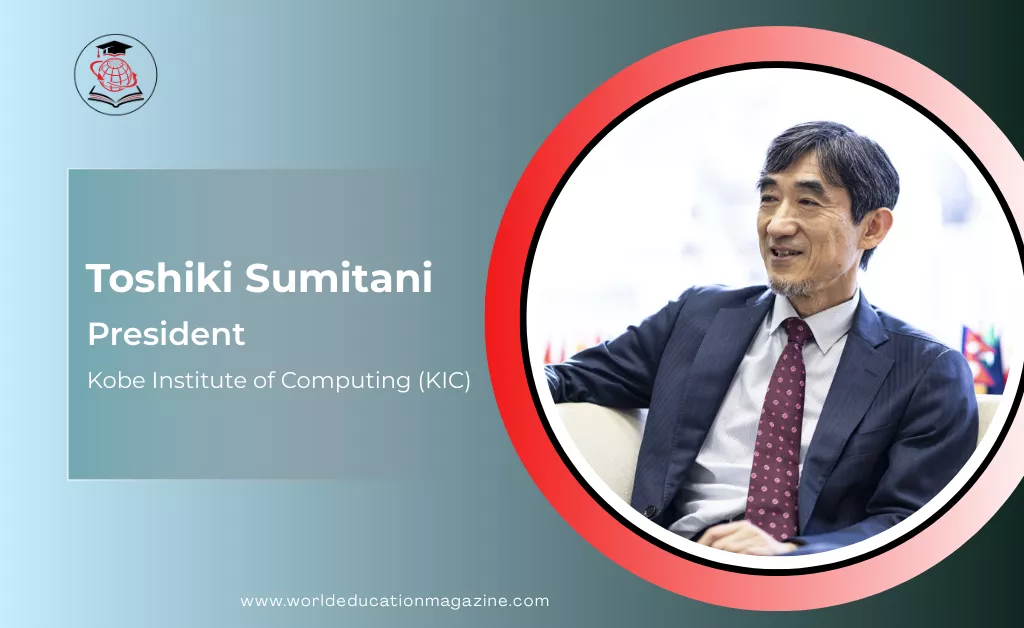
In an era where traditional education struggles to keep pace with technological advancement and societal change, Toshiki Sumitani stands as a transformative force. As President of Kobe Institute of Computing (KIC), he has spent decades challenging Japan’s standardized education model, replacing conformity with individuality and passive learning with active problem-solving that addresses real-world challenges.
Breaking Free from Educational Conformity
Toshiki Sumitani’s journey toward educational innovation began with critical observation of Japan’s rigid, standardized education system. Recognizing how traditional approaches failed to prepare students for rapidly evolving global demands, he sought alternatives that would honor individual strengths rather than enforce uniformity.
The turning point arrived during his time in Denmark, where he encountered an educational philosophy emphasizing individualized learning and student empowerment. This experience fundamentally shifted his perspective on education’s purpose. “My vision for education isn’t just about teaching technical skills. It’s about empowering students to become problem-solvers, to understand their potential, and to use their knowledge to make a difference in the world,” Toshiki explains.
Motivated by this revelation, Toshiki established LearnNet Global School in 1996, Japan’s first inquiry-based alternative school. This pioneering model attracted widespread attention, ultimately leading Kobe Institute of Computing leadership to invite him to implement his educational philosophy within their graduate programs, particularly for students studying information and communication technology.
Building a Global Laboratory for Social Innovation
Under Toshiki’s leadership spanning 15 years, KIC has evolved from a traditional computing institute into a dynamic global hub where technology meets social responsibility. His approach emphasizes empowering students to actively explore how their technical skills can address pressing societal challenges, moving far beyond mere knowledge acquisition.
The institute now serves students from over 100 countries, many of whom have returned to their home nations as leaders driving meaningful social change. This international reach reflects Toshiki’s commitment to creating socially aware, technically skilled graduates who view education as a catalyst for positive transformation.
The Tankyu Method Revolution
Central to KIC’s success is Toshiki’s innovative “Tankyu Method,” a proprietary curriculum framework that applies information technology to solve social issues through structured inquiry. This methodology has been expanded globally, reaching students across continents and earning recognition as a breakthrough approach to computing education.
The Tankyu Method encourages students to identify authentic problems, research potential solutions, develop technical interventions, and measure real-world impact. This cycle transforms passive learners into active change agents who understand that technical expertise carries social responsibility.
Redefining Education for an AI-Driven Future
Toshiki envisions education’s future built on three foundational principles: personalized optimization, borderless learning, and practical problem-solving. He believes artificial intelligence makes it increasingly possible to tailor education to individual interests and aptitudes, moving beyond one-size-fits-all approaches that dominated previous generations.
“Education must transform into a journey of purposeful exploration and impact-driven practice,” he asserts. This vision positions learning as an ongoing engagement with society and nature rather than confinement within traditional institutional walls.
Harnessing Generative AI’s Transformative Power
Looking ahead, Toshiki predicts that generative AI will fundamentally reshape computing education by accelerating learning and creation processes. “The boundaries of what is possible in computing education will continuously be pushed,” he notes, envisioning instantaneous sharing of human knowledge and wisdom that transforms collaboration and innovation pace.
Rather than viewing AI as a threat to traditional education, Toshiki sees it as an enabler of truly personalized learning experiences. This technology allows educators to scale individualized attention while students gain access to vast knowledge repositories, democratizing education in unprecedented ways.
Cultivating Visionary Leadership Through Collaboration
To Toshiki, visionary educational leadership transcends conventional practices and envisions competencies critical for evolving global landscapes. Such leaders identify effective methods for acquiring essential skills while gathering necessary resources including people, technology, and funding to realize their vision.
“A visionary leader is not just about making decisions; it’s about fostering an environment where innovation and collaboration thrive,” Toshiki explains. By encouraging students and faculty to think beyond established boundaries, he creates transformative educational experiences that prepare learners to thrive in uncertain futures.
Key leadership attributes Toshiki champions include:
Forward-thinking perspective that anticipates future skill requirements rather than simply responding to current demands, ensuring graduates remain relevant as industries evolve.
Resource mobilization capability to attract talented faculty, secure advanced technology infrastructure, and obtain funding that sustains innovation over time.
Collaborative mindset that values diverse perspectives and creates environments where creativity flourishes through respectful exchange of ideas.
Diversity as Innovation Catalyst
Diversity and inclusion form fundamental pillars at KIC, where Toshiki has deliberately cultivated a multicultural environment. The institute brings together students and faculty from Africa, the Middle East, Asia, and beyond, combining varied cultural backgrounds with deep expertise in information technology and applied fields.
“By embracing diverse perspectives and experiences, we drive creativity and impactful problem-solving in meaningful ways,” Toshiki emphasizes. He recognizes that homogeneous environments limit innovation potential, while multicultural collaboration generates solutions impossible within narrow contexts.
This commitment to diversity extends beyond geographical representation to include varied thinking styles, disciplinary backgrounds, and life experiences. Such richness creates learning communities where students encounter perspectives that challenge assumptions and expand possibilities.
Recognition of Educational Excellence
Toshiki’s innovative leadership has earned KIC multiple prestigious national and international accolades. The institute received the JICA President’s Award for educational innovation, recognition as Japan’s most sustainable university, and acclaim as the most agile educational leader in the Asia-Pacific region.
These achievements reflect more than institutional pride. They validate Toshiki’s conviction that education can simultaneously advance technical excellence and social responsibility, preparing graduates who succeed professionally while contributing meaningfully to global challenges.
Wisdom for Emerging Educational Pioneers
When advising emerging educational leaders, Toshiki encourages stepping beyond traditional frameworks to immerse directly in society and nature. He believes profound innovation emerges at the intersection of diverse perspectives and lived experiences.
“Seek out diverse experiences that expand your understanding of both artificial, virtual worlds and the tangible, real-world dynamics of nature and living beings,” Toshiki advises. He urges future leaders to pursue optimal blends of contrasting realms, recognizing that breakthrough insights rarely emerge from comfortable familiarity.
This wisdom reflects his own journey from observing Denmark’s alternative education model to establishing Japan’s first inquiry-based school and ultimately transforming a traditional computing institute into a global innovation hub.
Education as Engine for Meaningful Change
Toshiki Sumitani’s two-decade journey demonstrates that education can transcend knowledge transmission to become a powerful engine for societal transformation. By challenging standardized approaches, embracing diversity, leveraging emerging technologies, and maintaining unwavering focus on real-world problem-solving, he has created an educational model that prepares students not just for careers but for lives of purposeful impact.
As artificial intelligence reshapes every industry and global challenges demand innovative solutions, Toshiki’s vision of personalized, borderless, impact-driven education offers a compelling path forward. His work at Kobe Institute of Computing proves that when education prioritizes individual potential over conformity and social contribution over credential accumulation, it unleashes human capacity for meaningful change that extends far beyond classroom walls.