
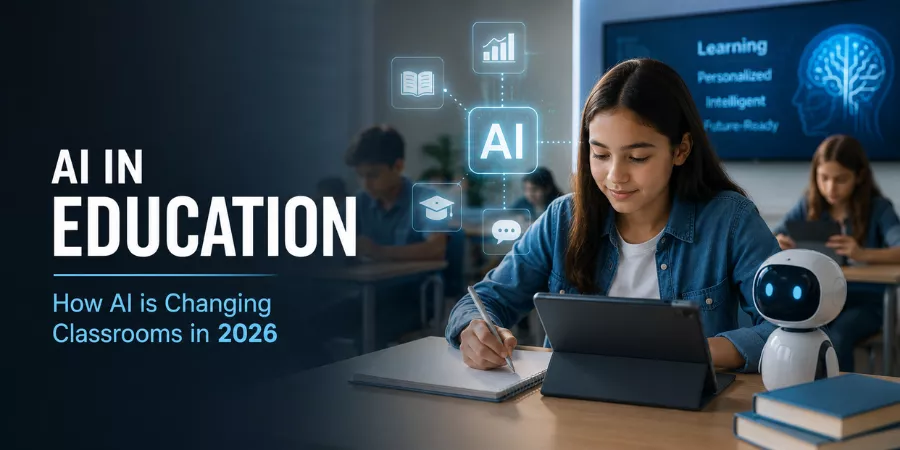
AI in education is changing classrooms in 2026 by making learning more personalized, giving students on-demand tutoring and feedback, helping teachers create instructional materials, automating routine work, and changing how schools assess student work.
At the same time, it is raising difficult questions about academic integrity, privacy, bias, critical thinking and equal access. The strongest current evidence points toward a teacher-led model in which AI supports learning rather than deciding how students learn.
In practical terms, AI in education is doing 5 things particularly well:
- Personalizing learning
- Providing AI tutoring and immediate support
- Assisting teachers with planning and feedback
- Supporting assessment and learning analytics
- Creating a need for new AI literacy and governance
The interesting part is that the conversation has moved beyond whether schools will use AI. In 2026, the more useful question is how schools can use it without weakening the very thing education is supposed to build: the student’s ability to think independently.
What Does AI in Education Mean in 2026?
AI in education refers to the use of artificial intelligence to support teaching, learning, assessment and educational administration. It includes adaptive learning systems, intelligent tutoring, generative AI, automated feedback, learning analytics and AI-assisted content creation.
Not all educational technology is AI.
A digital textbook is not necessarily AI. Neither is an LMS, an online quiz or a recorded lecture.
AI-powered systems can do something different. They can analyse information, generate content, identify patterns and respond to users.
That includes:
- Adaptive learning that changes difficulty based on student performance .
- AI tutors that respond conversationally .
- Generative AI in education for creating explanations, exercises and learning materials.
- Automated feedback
- Predictive and learning analytics
- AI-assisted lesson planning
But there is an important difference that tends to get lost in the excitement.
Making a task easier is not the same as making a student learn more.
The OECD’s 2026 Digital Education Outlook makes this distinction particularly clearly. General-purpose GenAI can improve the quality of a student’s immediate output without necessarily improving the underlying knowledge or skills. When AI is used with a deliberate teaching purpose, however, the evidence is considerably more encouraging.
That distinction should probably sit at the centre of every conversation about AI in education.
How is AI Changing the Student Experience?
AI is changing the student experience by giving learners more personalized practice, immediate feedback, conversational tutoring, accessibility support and assistance outside normal classroom hours.
This is perhaps where the change feels most obvious.
A student no longer necessarily has to wait until tomorrow to ask, “Why did I get this wrong?”
Personalized learning
One of the biggest opportunities for AI in education is personalization.
The basic process looks something like this:
Student performance → AI identifies a gap → difficulty or content changes → student receives targeted practice.
A teacher can identify that a student is struggling with fractions. AI can help surface that pattern much faster across a large set of student interactions and suggest appropriate practice.
That does not mean the algorithm should decide what happens next.
The teacher still needs to understand why the student is struggling.
That difference is vital since personalization without human interpretation can become little more than automated sorting.
AI tutors can provide support outside class
AI tutoring is another major development.
Students can use conversational systems for:
- Explanations
- Practice questions
- Revision
- Homework support
- Socratic questioning
- Step-by-step guidance
- Additional examples
The newer generation of generative AI in education is different from older rule-based tutoring systems because it can hold a conversation and adapt its response to what the learner says.
Khan Academy’s Khanmigo is a useful real-world example. In its 2024–25 school year, more than 2 million students, educators and parents used Khanmigo, while nearly half of users were grassroots teachers using it for free across more than 70 countries.
And the more interesting development came in 2026. Khan Academy reported that giving its AI tutor structured information about a student’s recent learning history improved “next-item correctness” by a combined 6.1% points across more than 15 million tutoring threads tested over six months.
That is a useful case study because it shows where AI in education becomes genuinely interesting: not simply when AI can answer a question, but when it can use learning context to provide better support.
Immediate feedback changes the learning loop
Traditional feedback often arrives after the student has already moved on.
AI can shorten that loop.
A student makes an error, receives an explanation, tries again and gets another response.
That can make practice more interactive.
The U.S. Institute of Education Sciences is even funding research into AI-generated immediate feedback for open-response mathematics questions because a significant portion of existing curriculum questions do not receive immediate feedback.
Accessibility and language support
The benefits of AI in education also extend beyond academic performance.
AI can support:
- Translation
- Captions
- Speech-to-text
- Simplified explanations
- Multilingual learning
- Differentiated materials
- Support for some learners with disabilities
The OECD’s 2026 AI literacy framework notes that AI can provide differentiated and individualized support, including for learners with special educational needs or disabilities, although the evidence around GenAI’s effectiveness remains mixed.
But here is the caveat we would keep repeating: AI should help a student think, not think instead of the student.
How is AI Changing the Teacher’s Job?
AI is changing teachers’ work by assisting with lesson planning, material creation, feedback, student-data analysis and routine administration while increasing the need for teachers to evaluate AI-generated content.
This is where the role of AI in education becomes much more nuanced.
The popular fear is that AI will remove teachers from the classroom.
The more realistic possibility is that it changes what teachers spend their time doing.
Lesson planning
Teachers can use AI to generate:
- Lesson outlines
- Examples
- Worksheets
- Quizzes
- Discussion questions
- Differentiated materials
- Classroom activities
The OECD reports that 37% of lower-secondary teachers used AI for their job in 2024, while 57% agreed that AI can help write or improve lesson plans.
The point is not that AI can create a lesson plan.
It obviously can.
The point is whether the teacher can look at that lesson plan and say, “This will work for my students” or “This completely misses what my class needs.”
That judgement remains human.
Grading and feedback
AI can assist particularly well with repetitive tasks such as:
- Multiple-choice assessment
- Basic formative feedback
- Grammar checking
- Rubric assistance
- Identifying patterns in responses
But final judgement is another matter.
A machine can identify that an answer differs from a model answer. A teacher can understand that a student gave an unusual answer because they misunderstood the concept, interpreted the question differently or are developing an argument that deserves further discussion.
Those are not the same thing.
Finding learning gaps
This is one of the more practical AI in education examples.
Instead of a teacher manually going through hundreds of responses, AI can help surface patterns:
- Which students repeatedly make the same error?
- Which concept is causing difficulty?
- Which students have moved ahead?
- Which students need additional practice?
At Enid High School in Oklahoma, educators piloted Khanmigo in a geometry class and used performance data to group students and assign targeted practice. The school also reported that students who were less comfortable asking questions publicly were asking Khanmigo questions directly and receiving immediate support.
That is a much more interesting use of AI in education than simply asking a chatbot to write a worksheet.
How is AI Changing Assessment in 2026?
AI is forcing schools to reconsider assessments that measure only the final product because generative AI can now produce essays, answers, code, presentations and summaries.
This may be one of the most important changes happening in AI in education.
For years, an essay submitted at home was treated as evidence that the student could write the essay.
That assumption is becoming harder to defend.
The question now is not simply:
Did the student produce a good answer?
It is:
Can the student explain, defend and reproduce the thinking behind the answer?
Schools are therefore experimenting with approaches such as:
- In-class writing
- Oral examinations
- Draft-and-revision assessment
- Process portfolios
- Oral defenses
- AI-use disclosure
- AI-aware rubrics
- More supervised assessments
The OECD reports that 72% of lower-secondary teachers believe AI can harm academic integrity by allowing students to pass off AI-generated work as their own.
That does not mean every assignment needs to become an exam.
It means assessment needs to become harder to fake and better aligned with the skills schools actually want students to develop.
And this may ultimately be a good thing.
What are the Benefits of AI in Education?
The main benefits of AI in education are personalization, immediate feedback, accessibility, teacher assistance, learning-gap detection and support for learning beyond classroom hours.
The strongest potential benefits include:
- More personalized instruction
- Faster feedback
- Additional tutoring support
- Better differentiated instruction
- Accessibility and language assistance
- Teacher productivity
- Identification of learning gaps
- Support for educational administration
But we would add one sentence that is often missing from lists of the advantages of AI in education:
The benefit does not come from AI itself. It comes from what AI enables a teacher or student to do better.
The OECD reaches a similar conclusion. GenAI can support learning when it is used with clear pedagogical intent, but simply outsourcing cognitive work to a general-purpose chatbot can improve task performance without producing durable learning gains.
That is an important distinction.
What are the Risks of AI in Education?
The biggest risks of AI in education include academic dishonesty, overreliance, weaker independent thinking, inaccurate AI outputs, privacy concerns, algorithmic bias, unequal access and the potential erosion of teacher judgement.
The negative effects of AI in education are not hypothetical concerns. They are already influencing how education systems think about policy and assessment.
- Academic integrity: Students can use AI to complete work they were expected to do themselves.
- Overreliance: If every difficult problem is handed to a chatbot, students may never develop the ability to struggle productively with difficult problems.
- Critical thinking: The danger is not that AI gives students information and the danger is that students stop questioning it.
- Hallucinations and inaccurate information: AI can confidently provide an incorrect answer. Students therefore need to learn verification rather than treating AI output as authority.
- Privacy: Educational AI systems may process student information, learning histories and other sensitive data. Schools need clear rules around what is collected, where it goes and who can access it. The OECD identifies data protection, reliability, equity and academic integrity among the central policy challenges surrounding GenAI adoption.
- Bias: AI systems can reproduce or amplify biases in their underlying data and design.
- Unequal access: A school with strong infrastructure, trained teachers and reliable devices will not experience AI in the same way as a school without those resources.
- Teacher deskilling: There is also a quieter risk. If teachers stop designing, questioning and adapting lessons because AI does all the work, professional judgement can gradually weaken.
That is why UNESCO’s teacher competency framework emphasizes human-centred thinking, ethics, AI foundations, AI pedagogy and professional learning.
These are among the dangers of AI in education that deserve more attention than the simplistic fear that robots will take over classrooms.
Will AI Replace Teachers?
AI is unlikely to replace teachers because education depends on judgement, relationships, motivation, context and human understanding that AI cannot independently provide.
The more useful question is what teachers will stop doing.
A teacher’s job may gradually move from:
Content creator + grader + administrator
toward:
Teacher + mentor + learning designer + evaluator + AI supervisor
UNESCO’s position is similarly human-centred: teachers remain fundamental because AI cannot replicate human understanding of learners’ emotions and socialization.
So, the impact of AI in education may be less about removing teachers and more about changing what good teaching looks like.
What AI Skills Will Students Need in 2026?
Students need AI literacy: the ability to understand AI, evaluate its outputs, use it ethically and know when not to use it.
This is where education has to move beyond teaching students how to write better prompts.
Students need to know how to:
- Check whether an AI answer is accurate
- Verify sources
- Recognize hallucinations
- Protect personal information
- Disclose AI use appropriately
- Question AI-generated conclusions
- Decide when AI is useful
- Continue developing independent skills
- Use AI without outsourcing the learning process
The OECD and European Commission released an AI Literacy Framework in June 2026 focused on helping primary and secondary learners understand how AI works, critically evaluate its outputs and use it ethically and creatively.
UNESCO has also developed separate AI competency frameworks for students and teachers.
This is an important shift.
AI literacy is no longer simply a technology skill. It is becoming part of being an informed learner.
What Should Schools Do Before Adopting AI?
Schools should start with an educational problem rather than an AI tool, then establish teacher training, privacy safeguards, assessment rules, equitable access and measures of actual learning outcomes.
A sensible adoption process looks like this:
- Define the learning problem first
- Choose AI around the educational objective
- Train teachers before expecting adoption
- Set clear student AI-use rules
- Protect student data
- Test tools for accuracy and bias
- Redesign assessment where necessary
- Measure actual learning, not just engagement
- Provide equitable access
- Keep human oversight
This matters because buying an AI tool is not an education strategy.
A school can have the most sophisticated AI platform in the world and still teach badly.
What Does a Good AI-Powered Classroom Look Like?
A good AI-powered classroom uses AI for targeted support while keeping teachers responsible for instruction, judgement and relationships and students responsible for thinking.
Imagine a mathematics classroom.
8:30 a.m.: The teacher reviews learning data from the previous lesson.
9:00 a.m.: Students begin exercises at different difficulty levels.
9:20 a.m.: The system identifies five students struggling with fractions.
9:25 a.m.: The teacher works with those five students while the rest of the class continues practicing.
After class: Students who need more practice use an AI tutor.
Homework: Students disclose where AI was used and submit their reasoning, not just the final answer.
Teacher review
The teacher evaluates both the answer and the thinking behind it.
That, to us, is a far more useful vision of AI in education than a classroom where every student simply has a chatbot open.
There is already evidence pointing in this direction. At Cold Spring School in California, educators developed a “Human → AI → Human” model in which students begin with their own ideas, use AI as a support, and then return to their own thinking to revise and personalize the result. The school reports that 85% of its students were exceeding ELA standards, a 9% increase from the previous year.
The school itself reports those results, so they should be treated as a district case study rather than proof that AI alone caused the improvement.
Still, the philosophy is worth paying attention to.
The student starts with the human.
The student ends with the human.
AI sits in the middle.
What Will the Future of AI in Education Look Like?
The future of AI in education is likely to involve more purpose-built educational AI, AI-aware assessment, stronger teacher training, better adaptive tutoring and tighter requirements around privacy, safety and human oversight.
The direction is already becoming visible.
The OECD’s 2026 outlook argues for educational AI that is grounded in learning science and designed with teachers and learners rather than simply importing general-purpose AI into classrooms.
That distinction could become extremely important.
The first wave was about putting AI into education.
The next wave will be about figuring out which uses actually deserve to stay.
Frequently Asked Questions
What is AI in education?
AI in education means using artificial intelligence to support teaching, learning, assessment and administration. Examples include adaptive learning, AI tutors, automated feedback, learning analytics and generative AI tools for creating educational materials.
How is AI changing classrooms in 2026?
AI is making instruction more personalized, feedback faster and teaching workflows more automated. It is also forcing schools to rethink assessment, academic integrity, AI literacy and the responsibilities of teachers and students.
How do teachers use AI in the classroom?
Teachers use AI for lesson planning, creating activities, differentiating materials, analysing student performance, generating feedback and handling some administrative tasks. The OECD reports that 37% of lower-secondary teachers used AI for their work in 2024.
How does AI personalize learning?
AI can analyse patterns in student performance and use them to recommend different levels of difficulty, practice activities or explanations. The teacher still needs to interpret those recommendations and decide what intervention is appropriate.
What are the benefits of AI in education?
The benefits include personalized learning, immediate feedback, tutoring support, accessibility, differentiated instruction, teacher assistance and better identification of learning gaps. However, the outcome depends heavily on how the technology is designed and used.
What are the risks of AI in education?
The major risks include academic dishonesty, overreliance, inaccurate information, privacy problems, bias, unequal access and reduced independent thinking. Poorly designed use can also weaken teacher judgement and student engagement.
Will AI replace teachers?
AI is unlikely to replace teachers because teaching involves relationships, judgement, motivation, context and emotional understanding. Instead, AI is more likely to change teachers’ responsibilities and automate some routine work.
How is AI changing student assessment?
AI is making traditional take-home assignments harder to use as evidence of individual learning because generative AI can produce sophisticated answers. Schools are therefore considering more process-based assessment, oral explanations, supervised work and AI-use disclosure.
How can students use AI responsibly?
Students should use AI to support understanding rather than simply obtain answers. They should verify important information, protect personal data, disclose AI use when required and make sure they can explain the reasoning behind their work.
What skills do students need in an AI-powered classroom?
Students need critical thinking, AI literacy, source verification, ethical judgement, digital safety and the ability to work independently without AI. The OECD’s 2026 framework specifically emphasizes understanding AI, evaluating its outputs and using it responsibly.
How can schools adopt AI responsibly?
Schools should identify the educational problem first, train teachers, establish clear AI-use policies, protect student data, test systems for bias and accuracy, redesign assessments where necessary and measure whether AI actually improves learning.
Final Takeaway
The biggest mistake would be to treat AI in education as another technology upgrade.
It is not.
A faster LMS did not force schools to reconsider what an essay means. A digital textbook did not make teachers wonder whether students still needed to memorize certain things. Generative AI does.
That is why the conversation around AI in education is ultimately not about chatbots.
It is about learning.
The technology can personalize practice, provide support at midnight, help a teacher see patterns hidden inside hundreds of responses and make some forms of educational assistance more accessible.
But it can also make it remarkably easy to avoid thinking.
That is the contradiction schools now have to manage.
The application of AI in education will be most valuable when it gives teachers better information, gives students better support and still leaves the difficult intellectual work where it belongs, with the learner.
In 2026, the smartest classrooms will probably not be the ones using the most AI.
They will be the ones that know when AI should step in, when a teacher should step in, and when the student needs to struggle through the problem alone.
That, ultimately, is where the future of AI in education will be decided.