
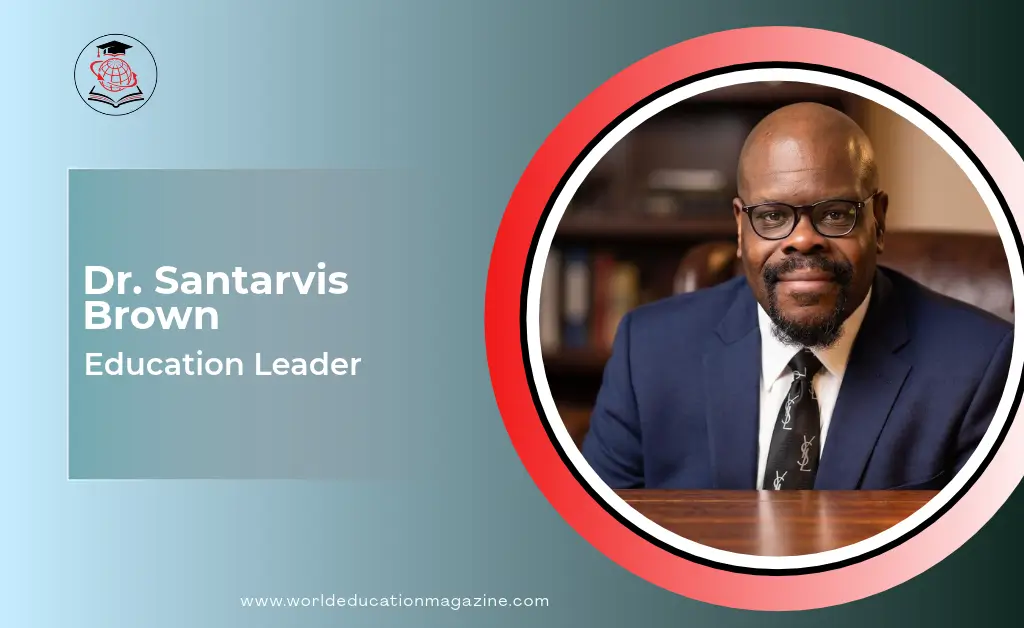
Challenging Outdated Practices and Building Institutions Around Student Success and Human Potential.
A student can attend classes, complete assignments and earn good grades, yet still leave school unsure of their abilities or place in the world. This raises an important question: are educational institutions preparing young people for life, or simply helping them move from one qualification to the next?
For Dr. Santarvis Brown, education must do more than deliver lessons and award credentials; it must help people recognise their potential, find their purpose and access opportunities that their circumstances might otherwise place out of reach.
His journey from classroom teaching to educational leadership has shown him how deeply institutional decisions determine individual futures. As artificial intelligence changes learning and workforce expectations continue to shift, Santarvis challenges education leaders to examine familiar systems, listen to students and imagine better ways forward.
Through his work across schools, universities and digital learning, he champions a vision in which educational excellence and equal access work together, giving more people the chance to build meaningful lives.
The Foundations of a Life in Service
Dr. Santarvis’s life has been formed by a fundamental belief that education can alter the trajectory of a person, a family, and ultimately a community. From an early age, he understood that opportunity is distributed unequally and that sometimes people need someone who sees potential in them before they can fully see it in themselves.
That realisation became foundational to his approach to education and service.
He also learnt that leadership is not primarily about position. It is about responsibility. It is about using whatever influence, education, resources, or access one has to make the road a little wider for the people coming behind. Throughout his life, educators, mentors, community leaders, and people of faith reinforced the importance of serving beyond oneself.
Those lessons became a calling that followed him from the classroom to school administration, higher education, nonprofit leadership, community service, and scholarship.
Discovering the True Purpose of Education
Before becoming a leader in education, Santarvis began his journey as an educator in the classroom. His early career included service as a teacher and assistant principal before he progressed into principalships and broader educational leadership.
Teaching taught him that education is deeply human work. He quickly discovered that students rarely remember every lesson teachers teach, but they remember whether their teachers believed in them. They remember whether they felt seen, challenged, respected, and valued.
That changed his understanding of education. Education is more than the transfer of information. It is the development of possibility. The real question is more than, “What does this student know?” It is also, “Who is this student becoming?” Great educators help students discover their voice, confidence, capacity, and purpose.
“Education is not simply the transfer of information. It is the development of possibility.”
Turning Experience into Leadership Wisdom
Several turning points determined Santarvis into the leader he is today. Moving from teaching into school administration taught him the power of systems. Serving as superintendent taught him the responsibility associated with leading an entire educational ecosystem. Higher education executive leadership expanded his understanding of institutional strategy, enrolment, academic quality, workforce alignment, accreditation, and sustainability.
At Miami Regional University, for example, Santarvis helped lead academic strategy during a period when enrolment grew from approximately 1,100 to more than 2,000 students while new graduate programmes were developed.
At Miami Dade College, directing a $10 million grant portfolio strengthened his understanding of accountability, partnerships, assessment, and responsible stewardship.
Every transition taught him that leadership becomes more powerful when experience is converted into wisdom.
Difference Between Administration and Visionary Leadership
For Santarvis, an effective administrator manages what exists, while a visionary leader imagines what could exist.
Administration matters. Budgets must balance. Accreditation standards must be met. Faculty need support. Students need services. Operations must function. However, visionary leadership goes further. Visionary leaders ask whether the system they are efficiently managing is actually the system students need.
A visionary leader sees around corners. They connect demographic changes, workforce trends, technology, culture, policy, and student needs before those forces become crises. Most importantly, visionary leaders inspire people to believe that transformation is possible.
“An effective administrator manages what exists. A visionary leader imagines what could exist.”
Rethinking Education in the Age of Artificial Intelligence
Education is changing rapidly through artificial intelligence, digital learning, new technologies, and changing workforce expectations. Santarvis believes institutions must stop treating technology as an accessory to education and begin thinking about how technology changes the nature of learning itself.
Artificial intelligence should prompt institutions to reconsider curriculum, assessment, faculty development, academic integrity, and workforce preparation. Students increasingly need critical thinking, ethical reasoning, creativity, communication, digital fluency, adaptability, and the ability to work alongside emerging technologies.
His work in digital and asynchronous education reinforced how technology can dramatically expand access. At Saylor Academy, initiatives supported an educational ecosystem serving more than 1.7 million learners globally.
However, technology must remain human-centred. The goal cannot simply be faster education. It must be better, more accessible, more relevant education.
“The goal cannot simply be faster education. It must be better, more accessible, more relevant education.”
Bringing Education and Law Together
Santarvis’s academic preparation includes advanced educational study and a Juris Doctor, which has significantly influenced how he thinks about institutional responsibility.
Education leaders make decisions within complex environments involving policy, governance, student rights, employee responsibilities, accreditation, contracts, regulatory compliance, and ethical obligations. Legal training teaches leaders to ask more than, “Can we do this?” They must also consider, “Should we do this? What precedent does it establish? Who might be affected? What responsibility does the institution carry?”
This training has made Santarvis more intentional about due process, accountability, documentation, governance, and ethical decision-making.
Challenging the Barriers to Innovation
One of the greatest barriers to educational improvement, according to Santarvis, is institutional attachment to yesterday.
Sometimes universities preserve processes because they are familiar rather than because they are effective. Innovation can also be slowed by bureaucracy, fear of failure, siloed departments, inequitable access to decision-making, insufficient resources, and a reluctance to listen meaningfully to students.
Institutions become student-centred when students stop being treated as numbers moving through systems and begin being understood as people navigating complicated lives.
Innovation requires courage: the courage to examine practices honestly, retire what no longer works, and redesign systems around student success.
Improving Recruitment, Retention and Student Success
Santarvis believes the first principle of student recruitment and retention is simple: recruitment makes a promise; the student experience must keep it.
Institutions should build integrated systems connecting enrolment, advising, faculty, academic support, financial services, career preparation, and student engagement. Data should help institutions identify students who may need intervention before difficulties become crises.
His leadership experience has included redesigning pathways and student-support structures specifically to strengthen retention, progression, belonging, and psychological safety.
Students persist where they experience three things: clarity, connection, and confidence. They need to understand the pathway, feel that someone knows they are there, and believe completion is possible.
“Recruitment makes a promise; the student experience must keep it.”
Recognising the Whole Student
According to Santarvis, educational institutions cannot solve every problem in a student’s life, but they cannot pretend those problems stop at the classroom door.
Housing insecurity, mental health concerns, family responsibilities, financial pressures, employment demands, discrimination, and isolation can profoundly affect achievement. Leaders must therefore create cultures where support is accessible without stigma.
That does not mean lowering academic expectations. Compassion and rigour are not opposites. Students can be held to high standards while being supported as whole human beings.
For him, student-centred education requires institutions to recognise the realities students face while maintaining their commitment to academic quality and achievement.
Why Collaboration is Vital
In Santarvis’s view, collaboration among educators, policymakers, businesses, and community organisations is essential.
No institution can prepare students for a world it refuses to engage. Educational institutions need employers to help identify emerging workforce needs. Policymakers need educators to explain the real-world implications of policy. Communities need educational institutions to function as anchors of opportunity.
Throughout his career, Santarvis has worked across colleges, schools, hospitals, community organisations, government agencies, and other partners to expand educational pathways and experiential learning opportunities.
Complex problems require collaborative solutions.
Words of Wisdom
As Santarvis looks towards the next chapter of his career, he remains focused on educational access, leadership development, artificial intelligence, workforce relevance, and the growing need to restore trust in educational institutions.
He wants to help build systems where a person’s geography, socioeconomic circumstances, age, or previous educational experiences do not permanently determine access to opportunity.
He is also deeply interested in developing the next generation of leaders. Education does not simply need more administrators. It needs courageous, ethical, imaginative leaders capable of navigating complexity without losing their humanity.
His advice to emerging educators reflects this belief. Rather than chasing leadership titles, he encourages them to chase problems worth solving.
They should become exceptional at serving people, learn how organisations work, and study budgets, strategy, policy, technology, assessment, and governance. They should listen to the people closest to the problem, find mentors, read relentlessly, and become comfortable receiving feedback.
Most importantly, they should determine what they believe before leadership tests those beliefs, because transformational leadership is about leaving the room and the institution better because one was there.
Developing an Educational Future Where Access and Excellence Meet
Santarvis wants to help create an educational future where excellence and access are never treated as competing ideas.
Students should be able to access education that is both accessible and exceptional. Technology should widen opportunity rather than deepen inequity. Leadership should create belonging rather than bureaucracy. Institutions should prepare students to earn credentials, build meaningful lives, and contribute responsibly to society.
When future generations look back, Santarvis hopes they will remember the impact of his work rather than every institution he led, programme he developed, article he published, or title he carried.
He hopes they will be able to point to students who received opportunities, faculty who became stronger educators, programmes that expanded access, institutions that became more responsive, and leaders who discovered the courage to lead differently.
A Legacy of Open Doors
Santarvis hopes his legacy will be measured less by the titles he held and more by the doors he helped open.
His career has allowed him to serve learners across K–12, higher education, online learning, community initiatives, executive administration, and faculty development. He has also contributed to leadership scholarship through books, articles, research, and international academic engagement, including presenting his research on leadership and organisational effectiveness at the Oxford University Research Symposium.
He wants people to remember him for making leadership more human, making education more accessible, and using his influence to create opportunities for others.
As one of the World’s 5 Most Visionary Leaders Transforming Education 2026, Santarvis hopes to carry this vision forward by helping build an educational future where a person’s circumstances do not permanently determine their opportunities, technology serves human potential, and leadership helps people feel that they belong.
Ultimately, he wants his life’s work to demonstrate one idea: education changes lives, but visionary leadership changes what education makes possible.