
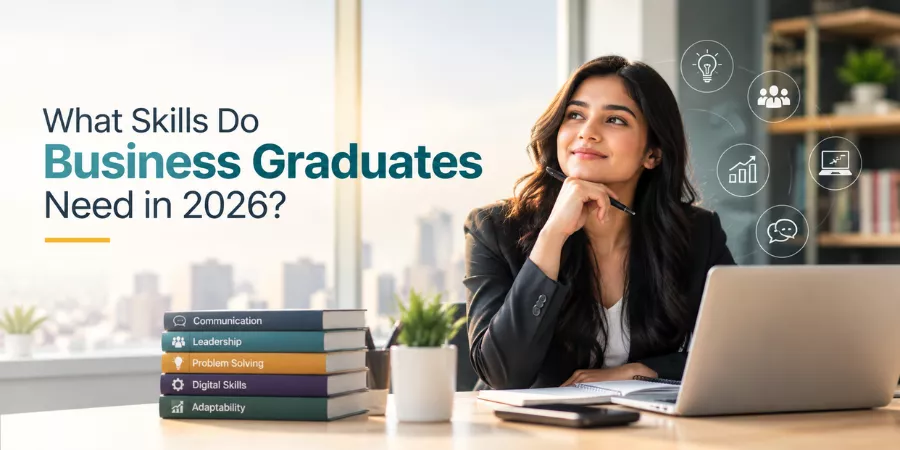
Business graduates in 2026 need AI fluency, analytical judgement, clear communication, adaptability and commercial awareness. The first is new. The rest are old skills that matter more now, because software has taken over the routine work that used to hide their absence.
A task that once took a junior analyst a full day, like summarising a market, drafting a report or cleaning a dataset, now takes an AI tool about a minute. The World Economic Forum’s Future of Jobs Report 2025 expects employers to see roughly 39% of workers’ core skills change by 2030, with analytical thinking ranked the most important skill of all. If the first draft is free, the person worth hiring is the one who knows whether the draft is any good.
Why is AI Fluency Now a Baseline Skill?
AI fluency means using AI tools to work faster while keeping responsibility for the result. It is closer to knowing how to use a search engine in 2005 than to knowing how to code.
The graduates who impress employers do a few things well. They give tools clear context instead of vague requests. They check outputs, because AI is confident even when it is wrong. They know what should never be pasted into a public tool, such as client data or confidential figures. And they can explain how they got an answer, not just what it was.
The test is simple: could you defend this work in a meeting if someone asked “how do you know?” If the answer is “the AI said so”, you have not done the job.
What Does Analytical Thinking Look Like in Practice?
Analytical thinking is the ability to break down a messy problem, weigh the evidence and commit to a recommendation. Knowing how to run a pivot table or build a dashboard is only the entry fee. Power BI, Tableau, advanced Excel and a little SQL all help, but the real skill is deciding which question matters.
A graduate who delivers twelve charts has produced information. One who says “churn is rising in customers who joined through discount campaigns, so we should test a different offer” has produced a decision. Employers notice the difference within weeks.
Practise this by always finishing the sentence “so what?” Every analysis you present should end with a recommendation, a risk and a next step.
Why Do Communication Skills Still Decide Careers?
Clear writing and confident speaking remain among the most requested skills in graduate hiring, and AI has made them rarer, not less important. When everyone can generate polished, generic prose, the person whose message is short, specific and obviously written by a thinking human stands out.
In practice that means emails that lead with the point, presentations that respect other people’s time, and the ability to disagree with a senior colleague without damaging the relationship. It also means being good in the new workplace: video calls, shared documents and asynchronous updates across time zones.
Nobody was ever promoted for sending the longest email.
How Do You Show Adaptability to Employers?
Adaptability is the speed at which you can learn something unfamiliar and become useful. The software you master at university may be outdated within three years. The habit of learning is the part that lasts.
Employers can’t see this on a CV, so give them evidence. Mention the certification you taught yourself, the tool you picked up for a society project, or the time a plan collapsed and you rebuilt it. Stories of change handled well beat any list of “fast learner” claims.
Why Does Commercial Awareness Matter More Than Ever?
Commercial awareness is understanding how a business makes money, where it loses it, and how your work connects to both. It sounds basic, yet it is one of the biggest gaps between graduates and experienced hires.
Learn to read a profit and loss statement. Understand margins, cash flow and unit economics. Follow the industry you want to join well enough to say something interesting about its competitors. A marketing graduate who can discuss customer acquisition cost, not just campaign creativity, gets listened to differently.
Which Human Skills Can’t Be Automated?
Leadership, emotional intelligence and ethical judgement sit underneath everything else. You don’t need a management title to show them. Take ownership of a problem. Notice when a teammate is struggling. Ask whether something is not only possible but right.
That last point is growing in importance. Sustainability reporting, responsible AI use and data privacy now shape strategy in almost every sector. Graduates who can raise an ethical concern calmly, with evidence, earn trust quickly.
How Can Business Graduates Build These Skills?
- Do real work. Internships, live client briefs and freelance projects beat coursework for credibility.
- Build a portfolio. A case study, a dashboard or a written analysis shows more than a grade does.
- Add targeted certifications. Data analytics, project management or AI tools, chosen to fit the roles you want.
- Compete and present. Case competitions and societies build teamwork and nerve.
- Write in public. Sharing your thinking on LinkedIn builds communication skills and visibility together.
Conclusion
Technology has not made business graduates less necessary. It has removed the easy parts of the job and exposed the hard ones: thinking clearly, communicating honestly, learning continuously and caring about the outcome. The graduates who thrive in 2026 will use AI to go further, not to avoid going anywhere.