
Remember when getting help with a difficult subject meant waiting for a teacher, calling a friend or finding a tutor who happened to be available?
That has changed.
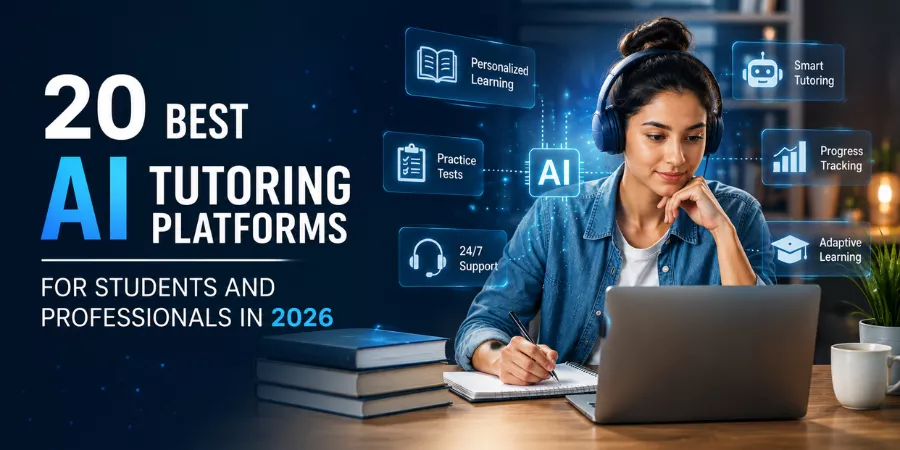
Today, AI tutoring platforms can explain a difficult concept, walk you through a maths problem, turn your notes into revision material, practise a language with you or help you prepare for an exam. The interesting part is not that AI can answer questions. It is that some platforms are now being designed to teach, not simply answer.
So, which ones are actually worth using?
There is no single winner. Khanmigo is a strong choice for structured academic learning, Photomath is particularly useful for maths, Quizlet works well for revision, ELSA Speak focuses on spoken English, and platforms such as StudyFetch are built around your own study material. Professionals may find general-purpose AI or course-based platforms more useful.
We have looked at these tools less as a list of shiny AI products and more as learning tools: What does it actually help you learn? Who is it for? And when does it make sense to use it?
What are the best AI tutoring platforms in 2026?
The best AI tutoring platforms depend on the learner, subject and purpose. A student struggling with algebra needs something different from a professional learning Python or someone preparing for an English-speaking test.
Here is the quick view:
| Platform | Best for | Why consider it |
| Khanmigo | Academic learning | Guided tutoring |
| TutorAI | General learning | Conversational learning |
| Tutorela | Human + AI tutoring | Private tutoring with between-lesson AI support |
| Gemini | General learning | Multimodal support |
| Brilliant | Maths and coding | Interactive lessons with an AI tutor |
| Photomath | Maths | Step-by-step solutions |
| ChatGPT | Broad learning | Flexible explanations |
| ELSA Speak | English | Pronunciation |
| Duolingo | Languages | Interactive practice |
| Quizlet | Revision | Flashcards and study |
| Brainly | Homework | AI and community support |
| StudyFetch | Study material | Notes and revision |
| Knowt | Exam revision | Flashcards and recall |
| Mindgrasp | Study assistance | Summaries and questions |
| Smodin | Writing | Writing support |
| Coursera Coach | Professional learning | Course-based guidance |
| Cognii | Institutional learning | Conversational assessment |
| Century Tech | Schools | Adaptive learning |
| Coursebox | Courses | AI-supported learning |
| SchoolAI/Coschool | Schools | Teacher and student tools |
Khan Academy reported that 2 million students, educators and parents used Khanmigo during the 2024–25 school year, a 731% year-over-year increase in sign-ups. That does not automatically make it the best tutor, but it does show how quickly AI-assisted learning is moving into mainstream education.
Which AI tutoring platforms are best for general learning?
Khanmigo, TutorAI, ChatGPT, Gemini and Socratic are good options when you want help across several subjects rather than a tool built around one particular skill.
1. Khanmigo: Best for structured academic learning
Best for: School students and educators
Khanmigo, for sure, is one of the most honest AI tutors rather than an AI chatbot since it is going to lead the students and is connected to Khan Academy.
Good for: Maths, science, humanities, coding and academic practice.
2. TutorAI: Best for exploring subjects
Best for: Students who want conversational learning
TutorAI gives you a more open-ended way of learning. You can raise questions, learn about a subject and continue discussions as you gain more knowledge and understanding.
Good for: General learning and exploring unfamiliar topics.
3. Tutorela: Best for combining human tutors with AI
Best for: Students who want private tutoring with continued learning support between lessons.
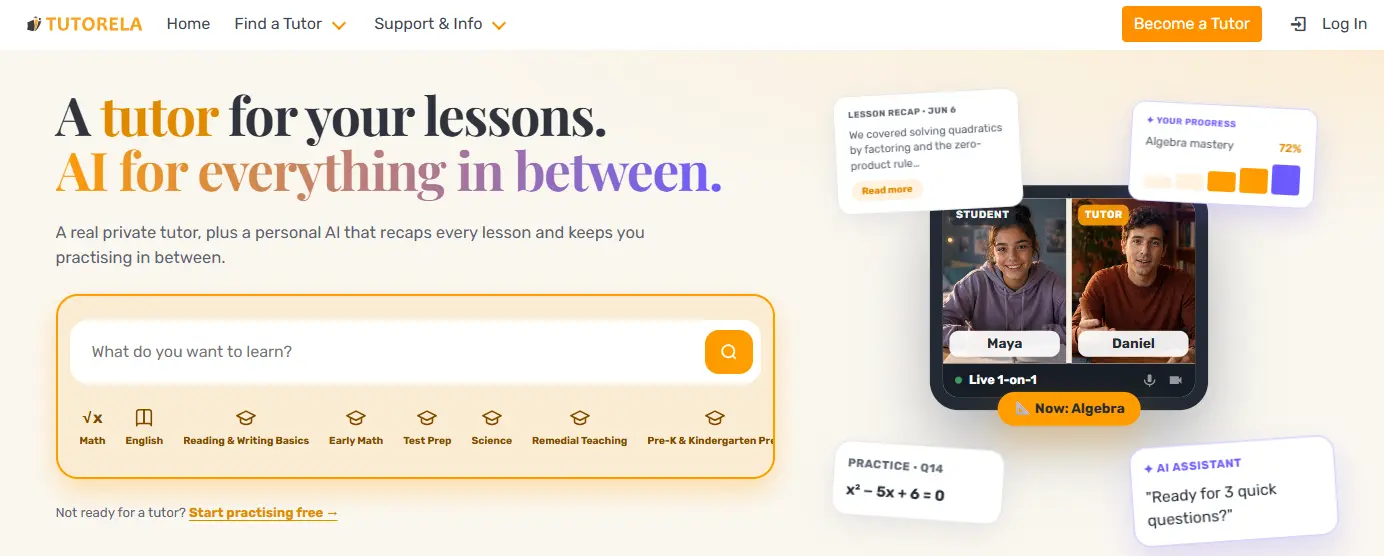
Tutorela takes a hybrid approach to tutoring: instead of asking students to choose between an AI tutor and a human teacher, it combines the two.
Students learn with a private tutor who provides guidance, motivation, and personal instruction, while technology supports the learning process outside the scheduled lesson.
Between sessions, AI can help students continue practicing, review mistakes, and identify areas needing more attention.
These insights can then help make the next lesson more focused, creating a learning cycle that continues beyond the hour spent with the tutor.
4. Gemini: Best for multimodal learning
Best for: Learners working with different types of material
Gemini can be useful when learning involves text, images, documents or other material. It is better thought of as a general AI learning assistant than a dedicated tutoring system.
Gemini may prove especially helpful when the subject matter involves text, images, documents, or other information. It’s best not to think of it as an AI tutor, per se. Rather, a general learning assistant, perhaps? And while it can do far more than just help with homework.
5. Brilliant: Best for maths and coding that actually stick
Best for: Parents whose children want to get genuinely good at maths and coding
Brilliant is built on a simple idea: a good tutor teaches, it does not just answer. Lessons are visual and interactive, so your child works through problems step by step instead of watching a video and hoping it sinks in.
Brilliant’s courses come with a built-in AI tutor called Koji. Koji works like an expert sitting right next to your child, asking questions and guiding them without giving away the answer. It can see what is on the screen and draws on it when your child is stuck, so help lands exactly where the confusion is.
Courses run from around age 10 through adult learners and cover maths from fractions through calculus, along with coding and problem solving. Parents get a dashboard with progress reporting, so you can see how your child is doing without having to sit next to them.
Good for: Maths, coding, logic, data and the thinking skills those subjects build.
| Feature | What it offers |
|---|---|
| Teaching style | Visual, interactive lessons with a tutor guiding step by step |
| AI tutor | Koji asks questions, draws on the screen and avoids giving away the answer |
| Age range | Around age 10 through adult learners |
| Subjects | Maths from fractions through calculus, plus coding and problem solving |
| For parents | Dedicated dashboard with progress reporting |
| For teachers | Brilliant for Educators, free for eligible K-12 teachers and their students |
Which AI tutoring platforms are best for maths, languages and revision?
If you are learning one particular subject, a specialised platform can sometimes be more useful than a general AI assistant.
6. Photomath: Best for maths
Best for: School and university students
Maths is one of these subjects where it is important for students to see the working out, not just the final answer. Photomath allows the user to see exactly how to get to the answer given.
This makes it one of the most useful AI tutoring tools as it allows students to see the problem worked out rather than just the final answer.
7. ChatGPT: Best for flexible learning
Best for: Students, university learners and professionals
ChatGPT is capable of going deeper if needed in explaining a concept, quiz making, questioning your ideas and reasonings and giving you feedback on how well you have understood the material. Probably its major advantage is its flexibility.
But you have to know that it is a tool first and how to get the most out of it. It really just becomes a waste of your time if you ask it simple questions to answer. But, once you have it ask you, challenge or test you, it has countless other ways to act as a teacher’s helper.
So, we are hoping that one day there will actually be chatbots available that will not only respond by giving answers to the user but also that will be used in helping learners to gain knowledge and understanding.
8. ELSA Speak: Best for English pronunciation
Best for: English learners and professionals
ELSA Speak aims not to provide a comprehensive English learning experience. The program focuses on specific areas only: achieving better speaking skills and accent.
That is why the application can be a great option for some learners. Moreover, in some cases, such a special focus is even more beneficial.
9. Duolingo: Best for language learning
Best for: Beginners and regular language practice
Duolingo makes use of bite-sized lessons and repetition to engage learners. It also features adaptive practice sessions with games, and as such, it is easier for the user to develop a learning routine than not.
10. Quizlet: Best for revision
Best for: Students preparing for exams
Quizlet is a handy tool for memorization and recalling previous information. It is a good idea to use this app if you are a learner looking for fun and effective ways to study. The different study methods include flashcards, practice questions, plus an artificial intelligence tool that helps to make the learning process more efficient and enjoyable.
Which AI tutoring platforms are best for homework and study material?
Brainly, StudyFetch, Knowt, Mindgrasp and Smodin are useful when you already have homework, notes, lectures or other study material and want help working through them.
11. Brainly: Best for homework support
Best for: School students
Brainly combines AI assistance with its established question-and-answer community. It can help students work through homework questions and create additional study material.
The important thing is not to turn it into an answer-copying service. The value is in understanding why the answer is correct.
12. StudyFetch: Best for your own study material
Best for: Students with lecture notes and documents
StudyFetch is useful if you already have a pile of notes and do not know where to begin. It can help turn study material into questions, summaries and other learning resources.
13. Knowt: Best for active recall
Best for: Exam preparation
Knowt is built around studying rather than simply asking questions. Its flashcards and revision features can be particularly useful for students who learn through repetition and active recall.
14. Mindgrasp: Best for making study material easier to digest
Best for: University students and independent learners
Mindgrasp focuses on turning educational material into more manageable study resources. It can be useful when you have lengthy material but limited time to organise it.
15. Smodin: Best for writing support
Best for: University students and writers
Smodin is more focused on writing and research than traditional tutoring. It can help with brainstorming, organising ideas and improving written work.
That does not mean students should hand over an assignment and submit whatever comes back. That is not learning. It is outsourcing.
Which AI tutoring platforms are best for professionals and schools?
Professionals and institutions generally need more than a chatbot. They need structured learning, assessment, progress tracking, curriculum alignment or teacher controls.
16. Coursera Coach: Best for professional learning
Best for: Professionals and university learners
A course-linked AI assistant can be useful when you are learning a specific skill. Instead of asking a general AI tool to teach you everything about data analytics, you can use AI alongside a structured course.
17. Cognii: Best for institutional learning
Best for: Schools and higher education
Cognii focuses on conversational learning and open-response assessment. That is useful because students sometimes understand a concept but struggle to express it, and sometimes the reverse is true.
18. Century Tech: Best for adaptive school learning
Best for: Schools and educators
Century Tech focuses on adaptive learning, with technology designed to identify learning needs and adjust pathways accordingly.
This is where AI teaching platforms become different from a simple chatbot. A school needs to think about an entire learning system, not just whether students can ask AI questions.
19. Coursebox: Best for structured courses
Best for: Educators and professional learning
Coursebox is aimed more at AI-supported course creation and learning than casual homework help. It makes more sense for organisations and educators building structured learning experiences.
20. SchoolAI/Coschool: Best for school ecosystems
Best for: Schools, teachers and students
School-focused platforms are trying to solve a bigger problem: how students, teachers and administrators can use AI within the same learning environment.
That is an important distinction. A tool that works brilliantly for one student may not be appropriate for an entire school.
Which AI tutoring platform is best for your needs?
The best platform changes depending on what you are actually trying to accomplish.
| Your goal | A good place to start |
| Structured academic tutoring | Khanmigo |
| Maths | Photomath |
| STEM homework | Gauth |
| English pronunciation | ELSA Speak |
| Language learning | Duolingo |
| Exam revision | Quizlet or Knowt |
| Homework | Brainly or Socratic |
| Study from your own notes | StudyFetch |
| Writing help | Smodin |
| Professional learning | Coursera Coach |
| General explanations | ChatGPT or Gemini |
| School-wide learning | Century Tech or SchoolAI |
How should you choose an AI tutoring platform?
Look at the teaching method first, then consider accuracy, personalisation, curriculum support, price and privacy.
1. Does it teach or simply answer?
This is the big one.
If a student asks a maths question and the platform immediately produces the answer, the student may finish the homework without learning much.
A better system knows when to explain, when to ask a question and when to let the learner try.
2. How accurate is it?
AI tutors can make mistakes.
A 2025 systematic review examined 28 studies involving 4,597 K-12 students and found that intelligent tutoring systems generally had positive effects on learning, but the researchers also said more research was needed, particularly with longer interventions and more diverse samples.
So, yes, the technology is promising. No, we are not at the stage where you should blindly trust everything an AI tutor says.
3. Does it adapt to the learner?
A child who is struggling with fractions does not need the same explanation as a student who is preparing for calculus.
The better AI powered tutoring platforms try to understand where the learner is and adjust accordingly.
4. Does it fit the curriculum?
This matters enormously for students.
A tool can explain photosynthesis beautifully and still be of limited use if it does not match what the student actually needs to learn for their examination.
5. What does the free plan really offer?
Search for an AI tutor for students free and you will find plenty of options.
Just remember that “free” may mean limited messages, restricted features or a free trial.
6. How does it handle student data?
This becomes particularly important when choosing AI tutoring platforms for kids.
Parents and schools should check age requirements, data collection, account controls and privacy policies before allowing children to use an AI learning product.
Is ChatGPT an AI tutor or just an AI chatbot?
ChatGPT can absolutely be used as an AI tutor, but a dedicated tutoring platform may offer more structure around the learning process.
There is nothing magical about putting the word “tutor” on an AI product.
The real difference is what happens after you ask a question.
A general AI assistant can explain the topic. A dedicated tutor may also track your progress, follow a curriculum, give you targeted exercises and deliberately avoid giving you the answer too quickly.
So, if you are asking AI platform examples, ChatGPT belongs in the conversation. But it is not automatically the right choice for every learner.
Are AI tutors actually better than human tutors?
AI tutors are excellent for instant help and repeated practice, but they do not make human tutors unnecessary. The two can work very well together.
There is some encouraging evidence.
A 2025 randomized controlled trial involving 194 Harvard undergraduates found that students using a purpose-built AI tutor learned significantly more in less time than students in an active-learning classroom used as the comparison.
Another Harvard-affiliated study found that people practising writing with AI improved more on a later writing test than those practising without AI.
But this is not an argument for replacing teachers.
A teacher notices frustration. A teacher understands context. A teacher can change the entire lesson because the room is not getting it.
AI does not have that human judgement.
Are AI tutoring platforms safe for students?
AI tutors can be useful for students, but they should be treated as learning aids rather than unquestionable authorities.
Students and parents should watch for:
- Incorrect or fabricated information
- Over-reliance on AI
- Copying answers instead of learning
- Privacy concerns
- Inappropriate content
- Weak parental controls
- Academic-integrity problems
The safest approach is fairly simple: let AI help with the learning process, but keep humans involved in important educational decisions.
Frequently Asked Questions
What is the best AI tutor for students?
Khanmigo is a strong choice for structured academic tutoring, while Photomath is particularly useful for maths and Quizlet for revision. There is no universal winner.
What are the best free AI tutoring platforms?
Free options include tools such as ChatGPT’s free tier and selected free versions of education platforms. However, features and usage limits vary, so check the current plan before choosing one.
Which AI tutor is best for maths?
Photomath is one of the strongest choices for step-by-step maths support. Gauth and Khanmigo are also worth considering depending on whether you want problem-solving or broader tutoring.
Can AI tutoring platforms help college students?
Yes. University students can use them for explanations, revision, practice, coding and study organisation. They are most useful when they support coursework rather than replace the student’s own work.
Can professionals use AI tutors?
Yes. Professionals can use AI tutoring tools for coding, languages, business skills, certifications and technical subjects.
What are intelligent tutoring systems examples?
Khanmigo, Cognii and Century Tech are examples of systems that use AI to provide structured or adaptive learning support.
Can AI tutors replace teachers?
No. They can handle explanations, practice and routine support, but teachers provide mentorship, judgement, motivation and human context.
Are AI tutors accurate?
They can be helpful but can still make mistakes. Important academic, scientific or professional information should be verified.
What is the best platform for online tutoring?
It depends on whether you want AI-only tutoring, human tutoring or a combination. Compare teaching quality, subject coverage, curriculum fit, feedback and price before choosing.
Conclusion
The best AI tutoring platforms are not necessarily the ones with the most features.
They are the ones that fit the learner.
A child struggling with fractions may need Photomath. A student preparing for an exam may get more value from Quizlet. Someone learning English pronunciation needs something like ELSA Speak. A professional learning a new technical skill may prefer a structured course with AI support.
And there is one rule we would keep above all the others: Do not use AI to make learning easier. Use it to make learning better.
That is the difference between an AI tool that helps you finish your homework and one that actually helps you become better at the subject.