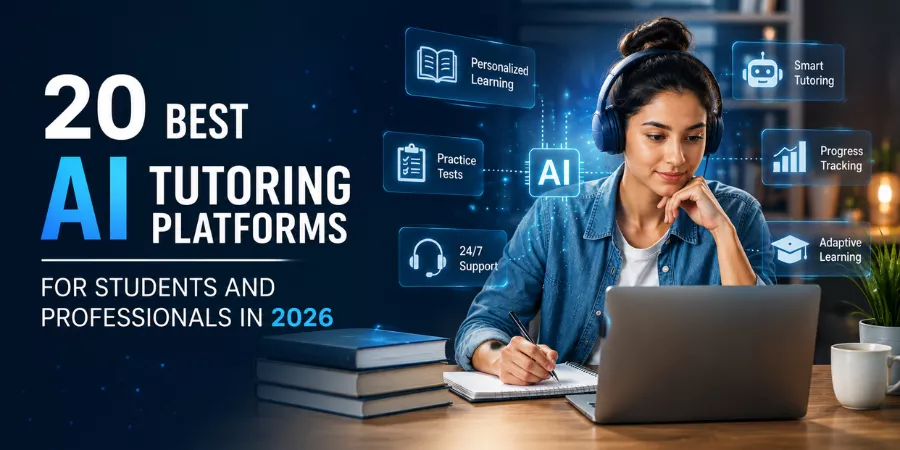

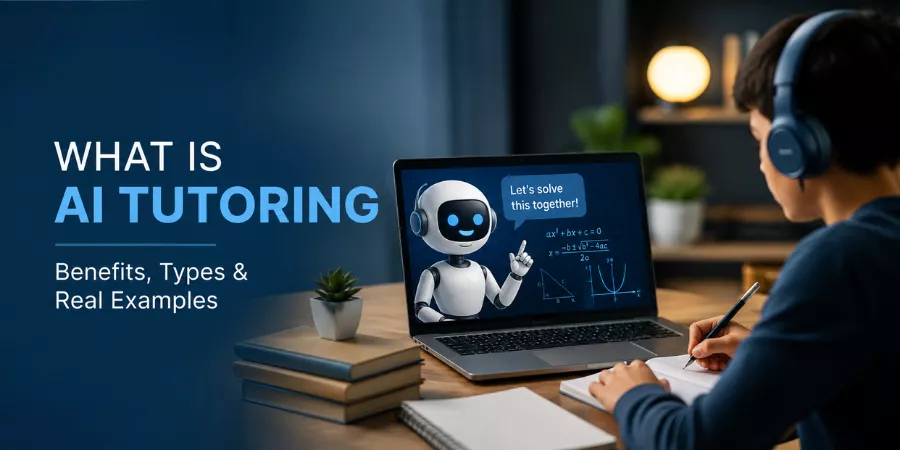
There is something slightly misleading about the phrase AI tutoring.
It sounds as if we have simply taken a chatbot, put the word “education” around it and called it a tutor. But good tutoring has never been about answering questions alone. A good tutor notices where you are struggling, changes the explanation, gives you another problem, knows when to stop helping and, importantly, knows when you need to figure something out yourself.
That is where AI tutoring becomes interesting.
AI tutoring is the use of artificial intelligence to provide personalized learning support based on a learner’s responses, progress and needs. An AI tutor can explain concepts, identify knowledge gaps, adjust difficulty, generate practice questions and provide immediate feedback.
The AI is now being applied in several areas like schools universities language education, programming skills development, exam readiness, and job training. Yet, its usefulness is really dependent on how well it’s developed and applied.
A 2025 systematic review of 28 studies involving 4,597 K–12 students found that AI-driven intelligent tutoring systems generally produced positive effects on learning and performance, although the advantage was less consistent when compared with other tutoring technologies rather than conventional teaching.
So, no, this is not simply another way of saying “ChatGPT for students.”
It is a much bigger conversation about how learning itself is changing.
AI tutoring at a glance
- What it does: Provides individualized instructional support.
- How it adapts: Uses learner responses, performance and interaction data.
- Who uses it: Students, teachers, universities, organizations and independent learners.
- Main benefits: Personalized learning, immediate feedback, flexible practice and scalable support.
- Main limitations: Accuracy, privacy, bias, over-reliance and limited human judgment.
What is an AI Tutor?
An artificial AI tutor is different from a human tutor as it is able to not just give information but also help a student in his/her learning journey.
In general terms, it is a computer program that communicates with the learner, gauges their answers and determines what they know and what they don’t. Further, it changes or directs the teaching to suit the learner based on this knowledge.
A capable AI tutor may:
- Assess answers and written responses
- Identify learning gaps
- Explain difficult concepts in different ways
- Give hints rather than immediately revealing answers
- Generate additional practice
- Adjust question difficulty
- Track student progress
- Recommend what to study next
- Provide real-time feedback
The important distinction is the feedback loop.
You answer a question. The system examines your response. It makes an assessment of what you appear to understand. It then decides what should happen next.
That could mean another question, a simpler explanation, a worked example or a more challenging problem.
That is closer to tutoring than simply asking an AI, “What is photosynthesis?”
Traditional intelligent tutoring systems have been doing versions of this for decades. Generative AI has made the interaction considerably more conversational and flexible.
How Does AI Tutoring Work?
An AI tutoring system typically follows a continuous cycle of interaction, assessment, adaptation and feedback. It observes learner responses, estimates their current understanding, adjusts instruction and then uses the next interaction to refine that assessment.
The process can be understood in 5 steps:
- The learner interacts with the system
The interaction could involve:
- A mathematics problem
- A multiple-choice assessment
- A writing assignment
- A coding exercise
- A spoken language conversation
- A question about a course topic
- The AI analyzes the response: The system determines if the answer is right and, based on its settings, might evaluate if the mistakes are patterned, and also, it may refer to the previous performance of the learner and his or her learning progression.
- It identifies learning needs: By doing this, Artificial Intelligence tutoring software becomes much superior to regular question-answering services. The machine, for instance, might realize that a child has got a hang of fractions but is having a tough time of converting them into decimals.
- The tutor adapts: The adaptive learning component can change the explanation, difficulty level, sequence of exercises or amount of practice. This is also where personalized learning becomes more than a marketing phrase. The learner is not necessarily following exactly the same path as everyone else.
- The learner tries again: The student receives real-time feedback, attempts another problem and creates new information for the system to evaluate. And the cycle continues.
Traditional intelligent tutoring systems often describe this architecture through four broad components:
- Domain model: What the system knows about the subject
- Student model: What it believes the learner knows
- Tutoring or pedagogical model: How it decides to teach
- User interface: How the learner interacts with it
Modern generative AI can make these interactions feel much more natural, but the underlying educational challenge has not disappeared: the system still has to understand how to teach, not merely what to say.
Is an AI Tutor the Same as ChatGPT?
No. A general AI chatbot can act as an AI tutor, but a purpose-built tutoring system is designed around learning objectives, learner progress and instructional decisions.
| Feature | General AI chatbot | AI tutoring system |
| Answers questions | Yes | Yes |
| Explains concepts | Yes | Yes |
| Tracks learner mastery | Limited or system-dependent | Core capability |
| Adapts learning sequence | Limited | Often central |
| Diagnostic assessment | Variable | Often built in |
| Curriculum alignment | Depends on setup | Usually stronger |
| Progress tracking | Variable | Common |
| Teacher dashboard | Usually absent | Often available |
This is why the AI tutor vs chatbot distinction is becoming important.
Ask a chatbot to explain calculus and it can probably give you an explanation. But that does not necessarily mean it knows whether you understand calculus.
A genuine tutoring system should be interested in what happens after the explanation.
- Did you get the next question right?
- Did you make the same mistake again?
- Are you ready for a harder problem?
- Or are you confidently repeating the wrong idea?
The line is becoming less clear as generative AI is incorporated into intelligent tutoring systems, but the educational purpose remains the useful dividing line.
What are the Types of AI Tutors?
There is no single type of AI tutor. AI tutors can be grouped according to what they teach and how they interact with learners.
Conversational AI tutors
These use natural language to explain concepts, answer questions and guide learners through problems.
They are particularly useful when a student wants to ask follow-up questions without worrying about whether the question sounds “basic.”
Adaptive intelligent tutoring systems
These systems model learner knowledge and adjust the sequence, difficulty or type of instruction.
They are the closest match to the traditional intelligent tutoring systems model.
Subject-specific AI tutors
These focus on areas such as:
- Mathematics
- Physics
- Chemistry
- Coding
- Biology
- Economics
A focused system can be useful because it can be designed around a particular curriculum and learning progression.
AI writing tutors
These can provide feedback on grammar, structure, clarity, argumentation and revision.
The better ones should help students understand why something needs improvement rather than simply rewriting everything for them.
AI language tutors
These can support:
- Vocabulary
- Grammar
- Conversation
- Pronunciation
- Listening
- Translation practice
AI exam-preparation tutors
These use practice questions, learner performance and revision history to help students concentrate on weaker areas.
AI tutors inside LMS platforms
Some AI tutoring in education is built directly into learning management systems, allowing tutoring, course content, assessments and learner records to sit in the same environment.
That integration may ultimately prove more important than having a clever chatbot sitting separately from the actual curriculum.
What are the Benefits of AI Tutoring?
The biggest AI tutoring benefits come from making learning support more available and more responsive to individual learners.
But there is an important distinction here: making tutoring available is not the same thing as guaranteeing learning.
Benefits for students:
- Personalized learning: An AI system can adjust explanations and practice based on individual performance rather than treating the entire class as though everyone has the same level of understanding.
- Immediate feedback: Students do not necessarily have to wait until the next class or assignment review to discover that they misunderstood something.
- Learning at an individual pace: A learner can spend longer on difficult material and move more quickly through concepts they already understand.
- More opportunities to practise: Students can repeat exercises without needing to schedule another tutoring session.
- 24/7 access: An AI tutor does not have office hours in the traditional sense. Support can be available late at night, early in the morning or during a weekend study session.
Benefits for teachers:
The AI tutor benefits are not limited to students.
A well-designed system can help teachers:
- Identify recurring misconceptions
- See patterns in student progress
- Provide differentiated practice
- Automate some routine feedback
- Identify students who may need intervention
- Spend more time on teaching and less on repetitive tasks
Benefits for universities and organizations:
AI in education can also support larger populations.
Universities can use tutoring systems for course support and revision. Companies can use them for onboarding, professional development, compliance learning and technical training.
That scalability is perhaps one of the strongest arguments for the technology.
A human tutor can only work with so many learners at once. Software can theoretically support thousands.
The word “theoretically” matters. Scaling a poor tutor simply creates more poor tutoring.
Does AI Tutoring Improve Learning Outcomes?
Is AI tutoring effective? The research so far suggests that well-designed intelligent tutoring systems can improve learning outcomes, but the evidence does not justify treating every AI tutor as equally effective.
This is where some of the excitement around AI tutoring needs to be tempered.
A 2025 systematic review published in npj Science of Learning examined 28 studies involving 4,597 K–12 students. The researchers found generally positive effects on learning and performance, particularly when intelligent tutoring systems were compared with traditional teaching. However, the gains were less pronounced when the systems were compared with non-intelligent tutoring systems. The researchers also called for longer interventions and larger, more diverse samples.
There is also encouraging evidence from higher education.
A randomized controlled trial published in Scientific Reports in 2025 compared a research-designed AI tutor with an active-learning classroom. The researchers reported that students using the AI tutor learned significantly more in less time and also reported higher engagement and motivation.
But that finding needs to be read properly.
It does not mean AI tutoring is automatically better than every teacher.
It means a carefully designed AI tutor, built around established teaching principles, can produce impressive results under the conditions studied.
There is a broader lesson here.
Research on traditional tutoring already shows that tutoring can have substantial learning effects. A 2024 systematic review and meta-analysis covering 89 randomized controlled trials found an overall tutoring effect of 0.288 standard deviations across pre-K–12 programs. The strongest effects tended to occur when tutoring was frequent, conducted during school and delivered by teachers or paraprofessionals.
So, the real question is not: “Is AI better than humans?”
It is: “Which parts of tutoring can AI perform well, and where does human expertise remain essential?”
That is a much more useful question.
What are Some Real Examples of AI Tutoring?
The easiest way to understand AI tutoring examples is to stop thinking about products for a moment and look at actual learning situations.
Example 1: AI math tutoring
A student gets an algebra equation wrong.
Instead of displaying the answer, the AI tutor asks which step they used to isolate the variable and provides a hint.
The student tries again.
That interaction is educationally more valuable than simply receiving the correct answer.
Example 2: Language learning
A learner practising English conversation repeatedly struggles with past-tense verbs.
The system can increase practice around that weakness rather than continuing to offer random vocabulary.
Example 3: Writing support
An AI writing tutor can point out that an essay has a weak argument structure and ask the student to strengthen the evidence.
The important part is that the student still does the thinking.
Example 4: University learning
A college student struggling with a difficult biology concept can ask for an explanation, attempt a practice question and then receive another explanation based on the mistake.
Example 5: Exam preparation
A student completes 50 practice questions.
Instead of simply showing a score, an adaptive system can identify recurring weaknesses and recommend what to revise next.
Example 6: Workplace learning
An employee taking a technical course can receive practice based on areas where their assessment performance indicates weaker understanding.
That is where AI tutoring in education starts extending beyond schools and universities into lifelong learning.
What are the Limitations of AI Tutoring?
AI tutoring can personalize instruction and provide fast feedback, but it can also produce incorrect information, encourage over-reliance, mishandle context and create privacy concerns. The limitations are not minor footnotes. They determine whether the technology is educationally useful.
- Accuracy and hallucinations: Generative AI can produce an answer that sounds authoritative and is completely wrong. That is particularly dangerous in education because students often do not yet know enough to recognize the error.
- Over-reliance: There is a fine line between helping someone solve a problem and solving it for them. If an AI tutor supplies every hint too quickly, the learner may complete more questions while actually developing less independence.
- Privacy: Tutoring systems can potentially process detailed information about learners, including performance, interactions and educational records. UNESCO has specifically called for stronger protection of data privacy and human-centred safeguards when AI is used in education.
- Bias: AI systems can reflect biases present in their training data or in the assumptions built into learner models and recommendations.
- Digital inequality: A technology that requires a good device, reliable internet and a paid subscription may help some learners while leaving others further behind.
- Limited human understanding: An AI may recognize that a student is repeatedly getting answers wrong. A teacher may notice that the student is exhausted, anxious, embarrassed, distracted or afraid to ask for help.
Those are not the same kind of knowledge. And education has always involved both.
Can AI Tutors Replace Teachers?
No. Not in the broader sense of teaching, mentoring and educating a person.
AI tutors can automate parts of tutoring, practice, assessment and feedback. They cannot reproduce the full role of a human educator.
| AI tutor | Human educator |
| Immediate practice | Sets learning goals |
| Automated feedback | Uses context and judgment |
| Progress analysis | Provides motivation |
| Adaptive exercises | Offers mentorship |
| Repeated explanations | Provides emotional support |
| Learning recommendations | Builds classroom relationships |
UNESCO’s teacher competency framework explicitly places human agency, ethics and pedagogy at the centre of AI-enabled education rather than treating teachers as obsolete.
We think this difference is important.
The best future is unlikely to be “AI instead of teachers.”
It is more likely to be teachers using AI to do some things better while remaining responsible for the things machines cannot responsibly own.
Is AI Tutoring Safe for Students?
AI tutoring can be safe when it is implemented with appropriate privacy protections, age-appropriate design, accuracy checks and human oversight.
Parents, teachers and institutions should examine:
- What student data is collected
- How long data is retained
- Whether conversations are used for training
- What privacy protections exist
- Whether parental or teacher controls are available
- How the system handles incorrect answers
- Whether students can challenge AI feedback
- What school policies govern its use
There is also a second kind of safety that gets overlooked: educational safety.
A technically secure application can still encourage unhealthy learning habits.
If a child learns that every difficult question should immediately be handed to AI, the technology may be safe from a cybersecurity perspective while being harmful to independent learning.
That distinction deserves much more attention.
Is AI Tutoring Useful for Children, College Students and Adults?
Yes, but the useful application changes with the learner.
- K–12 students: AI tutoring can support foundational skills, homework practice, revision and targeted exercises. Younger students need stronger adult supervision because they may have difficulty evaluating whether an AI response is correct.
- University students: College learners can use AI tutors for difficult concepts, revision, coding practice, writing feedback and independent study.
- Adult learners: For professionals, AI tutors can support certifications, technical training, onboarding and continuous skill development.
This broader use is worth watching. Education is no longer something that happens only between ages 5 and 22. As careers change faster, the ability to learn continuously becomes increasingly important.
How is AI Tutoring Different from Traditional Tutoring?
The simplest difference is availability.
| Factor | AI tutor | Human tutor |
| Availability | On demand | Usually scheduled |
| Scalability | Very high | Limited |
| Feedback speed | Immediate | Depends on tutor |
| Emotional support | Limited | Strong |
| Adaptation | Data-driven | Human judgment |
| Cost | Often lower at scale | Usually higher per session |
| Contextual judgment | Limited | Strong |
| Accountability | Limited | Stronger |
But there is one area where human tutoring still has a profound advantage: context.
A human tutor can remember that a student has had a difficult week. They can change their approach because they know the family situation, classroom dynamics or personality of the learner.
AI can model patterns. Humans can understand lives. The most sensible model may therefore be a blended one.
How Do You Choose an AI Tutor?
Do not choose an AI tutor simply because its website says “personalized.”
Ask what personalized actually means.
- Check curriculum alignment: Does the AI tutoring system match the learner’s curriculum, examination board or course?
- Evaluate feedback quality: Does it explain why an answer is wrong, or does it simply provide the correct answer?
- Look for adaptive learning: Does the system actually change the learning path based on performance?
- Test accuracy: Give it problems where you already know the correct answer.
- Review privacy practices: Understand what student information is collected, stored and shared.
- Check accessibility: Look at language support, speech capabilities, device compatibility and accessibility features.
- Examine teacher and parent controls: These are particularly important for younger students.
- Consider total cost: A free tool may have usage limits. A paid product may offer curriculum alignment, dashboards or institutional support.
- Test it with real learning tasks: Do not judge a tutor from its marketing demo. Give it the actual kind of problems the learner needs help with.
That will tell you much more.
What Does the Future of AI Tutoring Look Like?
The next generation of AI tutoring is likely to become less about text boxes and more about complete learning environments.
We are already moving toward:
- Multimodal tutoring
- Voice-based learning
- More sophisticated learner models
- Adaptive assessments
- AI tutors embedded in LMS platforms
- Multilingual tutoring
- Teacher-facing analytics
- Greater integration with course materials
- Stronger privacy and governance requirements
UNESCO’s student AI competency framework now emphasizes not just using AI but understanding its ethical implications, applying AI responsibly and developing the ability to critically evaluate AI systems.
That may be the more important development.
Students will not simply need AI tutors.
They will need to know when to trust them, when to question them and when to put them away and think for themselves.
Frequently Asked Questions About AI Tutoring
What is AI tutoring in simple words?
AI tutoring is the use of artificial intelligence to help someone learn. It can explain concepts, assess responses, adapt practice and provide feedback based on a learner’s needs.
What is an AI tutor?
An AI tutor is an AI-powered learning system designed to provide instructional support, such as explanations, hints, practice questions, feedback and personalized learning recommendations.
How does an AI tutor work?
An AI tutor typically collects learner responses, analyzes performance, identifies potential knowledge gaps, adapts instruction and provides feedback before repeating the process with the learner’s next interaction.
Is ChatGPT an AI tutor?
ChatGPT can be used as a tutor, but a general chatbot is not necessarily an intelligent tutoring system. A purpose-built tutoring system usually has stronger mechanisms for curriculum alignment, learner modelling, assessment and progress tracking.
What are the benefits of AI tutoring?
The main benefits include personalized learning, flexible access, immediate feedback, repeated practice, adaptive instruction and progress monitoring.
What are the disadvantages of AI tutoring?
The main concerns include inaccurate answers, privacy risks, bias, over-reliance, unequal access and the absence of human judgment and emotional understanding.
Can AI tutors replace teachers?
AI tutors can automate certain teaching and tutoring tasks, but they do not replace the broader role of teachers in motivation, mentorship, judgment, relationships and classroom learning.
Are AI tutors effective?
Research suggests that well-designed tutoring systems can improve learning outcomes, but effectiveness varies by system, subject, learner, intervention length and comparison group. The evidence does not support treating all AI tutors as equally effective.
What subjects can AI tutors teach?
AI tutors can support mathematics, science, languages, writing, coding, exam preparation and professional skills, although the quality of support depends on the system and subject.
Are AI tutors safe for children?
They can be used safely with appropriate privacy protections, age-appropriate design, accuracy checks and adult supervision. UNESCO recommends a human-centred approach with safeguards for AI use in education.
What is the difference between an AI tutor and an intelligent tutoring system?
An AI tutor is a broad term for AI used to provide tutoring support. An intelligent tutoring system traditionally refers to a more structured educational system that models the learner, subject knowledge and teaching strategy to provide adaptive instruction.
Can AI tutoring personalize learning?
Yes. A properly designed system can use learner responses and progress information to adapt explanations, practice, difficulty and learning sequences. That is the central idea behind personalized learning and adaptive learning.
How much does an AI tutor cost?
There is no single price. Some AI tutoring tools are free, while consumer subscriptions and institutional systems can charge recurring fees or licensing costs. The right comparison is not simply price but what the system provides for that price.
Final Takeaway
AI tutoring is best understood as a personalized learning system, not simply an AI that answers educational questions.
Its real value lies in the loop: understanding what a learner knows, identifying where they struggle, changing the instruction, providing useful feedback and giving them another opportunity to practise.
That sounds simple but it is not.
The difficult part of education has never been producing more information. We already have more information than any classroom could possibly use.
The difficult part is knowing what this particular learner needs next.
That is where AI has a genuinely interesting role to play.
But the research also gives us a reason to be cautious. The 2025 evidence base is encouraging, yet it is not a blank cheque for AI in education. The 28-study review involving 4,597 K–12 students found generally positive effects, but also highlighted weaker results against non-intelligent tutoring systems and the need for longer, more diverse research.
So perhaps the smartest way to think about AI tutoring is neither as the saviour of education nor its replacement.
It is a tool.
A remarkably powerful one, perhaps.
But like every educational tool before it, what matters most is not how impressive the technology sounds. It is whether the learner actually understands more, thinks more independently and becomes capable of doing something they could not do before.
That is the standard AI tutoring ultimately has to meet.