
Table of Contents
- The Creation of PISA: Measuring Education Globally
- Why PISA Results Shake Up National Education Systems
- From Physics Teacher to OECD Education Director
- Beyond Test Scores: What PISA Actually Measures
- Controversies and Criticisms of Global Testing
- Frequently Asked Questions
- The Future of Evidence-Based Education Policy
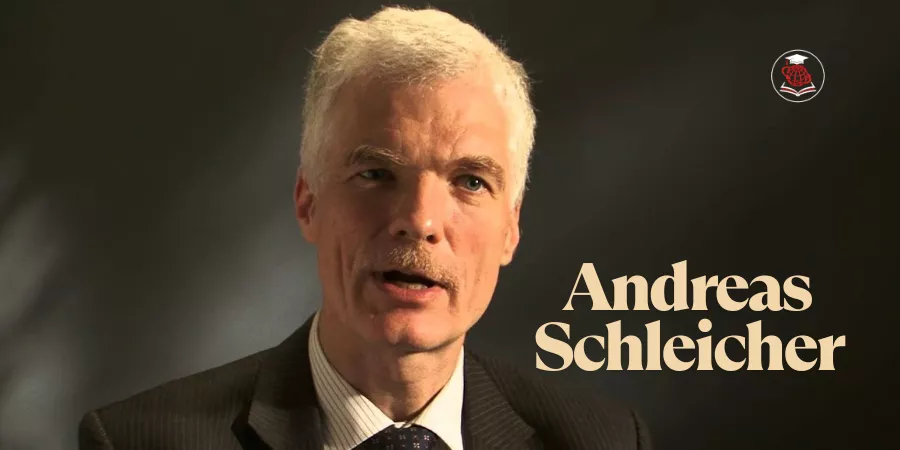
Andreas Schleicher wields extraordinary influence over global education through his role as Director of Education and Skills at the OECD and creator of the Programme for International Student Assessment, universally known as PISA. Every three years, PISA tests 15-year-olds across over 80 countries in reading, mathematics, and science, generating international rankings that trigger education reforms, political debates, and media headlines worldwide. Schleicher’s work transformed education from primarily national concern into global competition where countries obsess over their PISA rankings nearly as intensely as Olympic medal counts.
| Global Reach:
PISA assessments reach over 600,000 students across 80+ countries representing nearly 90% of the world’s economy, making it the most comprehensive international education measurement system ever created. |
The Creation of PISA: Measuring Education Globally
Before PISA’s launch in 2000, countries lacked reliable ways to compare educational performance internationally. National curricula, assessment systems, and educational philosophies varied so dramatically that meaningful international comparison seemed impossible. Schleicher and his team developed assessments measuring not curriculum-specific knowledge but rather students’ ability to apply knowledge to real-world problems, reasoning that such functional competencies matter more for future success than memorized facts.
PISA tests assess reading literacy, students’ ability to understand, use, and reflect on written texts; mathematical literacy, capacity to formulate, employ, and interpret mathematics in varied contexts; and scientific literacy, ability to engage with science-related issues and scientific ideas. The assessments deliberately avoid testing what students were taught, instead measuring whether they can think critically, solve problems, and apply knowledge in unfamiliar situations. This approach enables comparison across diverse educational systems with different curricula.
- 2000: First PISA assessment conducted in 43 countries
- Every 3 years: New assessment cycle focusing rotation on domains
- 2022: Latest cycle included 81 countries and economies
- 600,000+ students: Participate per cycle, representative samples
- Contextual questionnaires: Gather data on student backgrounds and schools
Why PISA Results Shake Up National Education Systems
PISA rankings generate extraordinary political and media attention because they provide seemingly objective evidence of educational success or failure. When Finland topped early PISA rankings, delegations from dozens of countries visited Finnish schools seeking to replicate their success. When PISA shock hit Germany after poor 2001 results, the country undertook comprehensive education reforms addressing inequities and updating curricula. Asian countries consistently topping rankings gain international prestige while lower-ranking nations face pressure to explain mediocre performance.
The rankings create policy windows where reform-minded education ministers can leverage poor PISA results to push changes that entrenched interests might otherwise block. Media coverage simplifies complex data into country rankings, creating public pressure for improvement even when such simplification distorts nuanced findings. Critics argue this horse-race mentality encourages unhealthy competition and test-focused education, but advocates counter that international benchmarking prevents complacency and reveals best practices that isolated national systems might never discover.
| PISA Shock Phenomenon:
Multiple countries including Germany, Japan, and Norway experienced political upheaval following unexpectedly poor PISA results, catalyzing education reforms that internal advocates had unsuccessfully promoted for years prior to international embarrassment. |
The Finland Phenomenon and Asian Excellence
Finland’s consistent top performance in early PISA cycles made it an international education celebrity, with features in documentaries, books, and countless education conferences. Finland’s success without standardized testing, homework, or competitive pressure challenged assumptions that high performance requires high-stakes accountability. Conversely, Asian countries like Singapore, South Korea, and Shanghai-China demonstrate that different approaches, including intensive study and competitive testing, also produce high achievement, suggesting multiple pathways to PISA success rather than single optimal model.
From Physics Teacher to OECD Education Director
Andreas Schleicher began his career as a physics teacher in Germany before transitioning to education research and policy. His background in physics influenced his empirical, data-driven approach to education policy, treating educational outcomes as phenomena requiring systematic measurement and analysis rather than ideological debate. He joined the OECD in 1994, where he developed educational indicators and eventually created PISA to provide rigorous international comparison data.
His role as OECD Director for Education and Skills gives him platform and authority that individual national education officials lack. Operating from an international organization rather than any single country allows Schleicher to promote evidence-based practices without nationalist biases, though critics argue OECD represents developed-country perspectives that may not suit all contexts. His frequent international speaking, prolific writing, and media presence have made him perhaps the most globally recognized education policy figure, rivaling researchers and advocates with far longer careers.
- 1964: Born in Hamburg, Germany
- Early career: Physics teacher and education researcher
- 1994: Joined OECD, developed education indicators
- 2000: Launched first PISA assessment
- Present: Director for Education and Skills, OECD
- Advisor: To governments worldwide on education reform
Beyond Test Scores: What PISA Actually Measures
While media coverage focuses on rankings, PISA data provides far richer insights into factors associated with educational success. The assessments include extensive questionnaires gathering data on student socioeconomic backgrounds, school resources, teaching practices, and educational policies. This enables analysis of equity, showing how much social background determines educational outcomes, and identification of practices associated with higher performance after controlling for demographic factors.
PISA reveals, for instance, that top-performing systems combine high expectations for all students with strong support for struggling learners rather than early tracking into ability groups. It demonstrates that teacher quality matters more than class size or technology investment. It shows that moderate homework and testing produce better outcomes than either excessive or minimal amounts. These evidence-based insights influence policy more substantially than simple rankings, though they receive less media attention than country standings.
Understanding how PISA data drives educational policy worldwide requires looking beyond rankings to the detailed analysis of educational practices, resource allocation, and systemic features that correlate with student achievement across diverse national contexts.
- Equity analysis: Measuring how social background affects achievement
- Resource effectiveness: Identifying which investments matter most
- Teaching practices: Documenting approaches associated with success
- Student wellbeing: Assessing belonging, bullying, and life satisfaction
- Digital literacy: Testing information evaluation and online reasoning
Controversies and Criticisms of Global Testing
PISA faces substantial criticism from educators, researchers, and policy analysts who question both its methodology and influence. Critics argue that standardized testing narrows education to measurable outcomes, neglecting creativity, character development, social-emotional learning, and other goals that tests cannot easily capture. They contend that international comparison encourages unhealthy competition, test preparation, and teaching to assessments rather than genuine learning.
Methodological critiques question whether tests developed primarily in Western contexts measure what matters across diverse cultures, whether comparing 15-year-olds captures educational system quality when countries differ dramatically in early childhood education and post-secondary pathways, and whether sampling and translation procedures ensure valid cross-national comparisons. Some researchers argue that PISA data supports correlation rather than causation, making policy prescriptions based on PISA findings potentially misleading.
| Critical Perspective:
Over 100 academics signed open letters criticizing PISA’s influence, arguing that international testing encourages educational standardization, neglects non-academic goals, and promotes market-oriented reforms that may harm educational quality despite improving test scores. |
Schleicher’s Response to Critics
Schleicher acknowledges PISA limitations while defending its value for international learning and accountability. He argues that critics who dismiss all standardized testing offer no alternative for systematic comparison, that PISA assesses applied knowledge rather than memorized facts, and that contextual questionnaires address many concerns about narrowness. He contends that countries ignoring PISA data risk complacency while those using it thoughtfully gain insights enabling evidence-based improvement. The debate reflects deeper tensions about education purposes, whether schools should optimize measurable outcomes or pursue broader developmental goals.
Frequently Asked Questions
What is PISA and why does it matter?
PISA is the Programme for International Student Assessment, testing 15-year-olds every three years in reading, mathematics, and science across 80+ countries. It matters because it provides the most comprehensive international comparison of educational performance, influencing billions in education spending, policy reforms, and public debates about school quality globally. PISA rankings generate political pressure for change and provide evidence about which educational practices associate with higher student achievement.
Who is Andreas Schleicher and what is his role?
Andreas Schleicher is Director for Education and Skills at the OECD and the architect of PISA assessments. He leads international education measurement, analysis, and policy advisory work, making him one of the most influential figures in global education despite never serving as education minister or leading a national education system. His work shapes how countries understand educational quality and design reforms based on international evidence.
Why do some countries always rank high in PISA?
Consistently high-performing countries like Singapore, Finland, and Estonia share certain characteristics including high teacher quality through selective recruitment and strong preparation, curriculum emphasis on deep understanding over broad coverage, strong support systems for struggling students, and cultures valuing education. However, they achieve high performance through different approaches, some through intensive study and competition, others through minimal testing and student autonomy, demonstrating multiple pathways to excellence.
Does high PISA ranking mean a country has the best education system?
Not necessarily, as PISA measures only reading, mathematics, and science competencies, neglecting arts, physical education, social-emotional development, creativity, and civic learning. Countries might achieve high PISA scores while producing stressed students, neglecting equity, or failing at other educational goals. PISA provides valuable but limited information about educational quality, and rankings should inform rather than dominate education policy discussions that must consider broader outcomes.
Can teachers improve PISA scores through test preparation?
Limited evidence suggests that targeted test preparation modestly improves PISA scores, but substantial gains require genuine educational improvement rather than coaching. PISA’s focus on applied reasoning rather than curriculum-specific knowledge limits test preparation effectiveness compared to curriculum-aligned exams. Countries that improve PISA performance typically implement broader reforms in teaching quality, curriculum, and student support rather than simply drilling students on test-taking strategies, suggesting that sustained improvement requires systemic change.
The Future of Evidence-Based Education Policy
Andreas Schleicher’s influence extends beyond PISA to promoting evidence-based education policy globally. His work established international benchmarking as normal practice, created demand for comparative data informing reform, and elevated education as global policy priority alongside economic and social issues. Whether this influence proves ultimately beneficial or harmful remains debated, with supporters crediting PISA with driving improvements and critics blaming it for narrowing educational vision.
The future likely involves expanded measurement addressing PISA’s acknowledged limitations. OECD has introduced assessments of collaborative problem-solving, global competence, and creative thinking, attempting to broaden evaluation beyond traditional academics. Whether these expanded assessments replicate PISA’s influence or whether countries eventually resist international comparison pressure remains uncertain. What seems clear is that Schleicher’s work permanently changed education from primarily national concern into global system where countries compare performance, learn from international evidence, and face pressure to match top performers, for better or worse depending on perspective.