

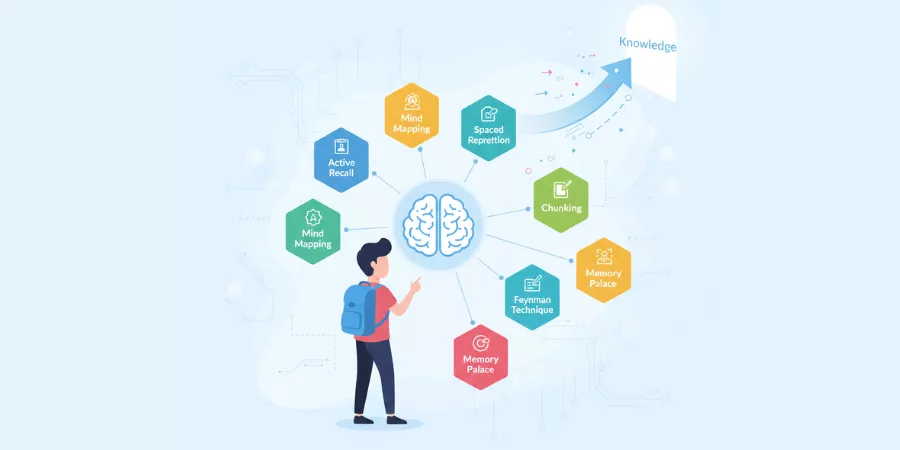
Staring at textbook pages for hours, rereading the same notes over and over, highlighting entire chapters in neon yellow these familiar study rituals feel productive but deliver surprisingly poor results. Research consistently demonstrates that the most common study methods are also the least effective for long-term retention. The average person can store approximately one million gigabytes of memory in their brain, yet most students utilize only a fraction of this capacity because they rely on passive learning techniques that fail to activate the brain’s natural memory systems.
Understanding how memory actually works transforms studying from an exhausting endurance test into a strategic, efficient process. The human brain creates two distinct types of memory: short-term memory screens information and stores it for mere seconds, while long-term memory archives information for extended periods. Educational psychology research reveals that for concepts to move from temporary working memory to permanent long-term storage, two critical conditions must be met the information must be memorable through emotional connection or unusual association, and it must be repeated in strategically spaced intervals. These cognitive principles form the foundation of every effective memorization technique, yet most students never learn them. The study hacks that follow aren’t trendy tricks or motivational platitudes. They’re scientifically validated strategies that work with your brain’s natural architecture rather than against it.
Why Your Current Study Method Probably Doesn’t Work
Research into learning effectiveness reveals an uncomfortable truth: reading is one of the most passive methods of learning and produces significantly lower retention rates than active methods requiring effort and interaction with material. When students simply reread notes or textbooks, they create what psychologists call the illusion of fluency material feels familiar when encountered repeatedly, generating false confidence that it’s been mastered. This familiarity doesn’t translate to actual recall ability when facing blank exam pages without reference materials.
A 2025 analysis of educational technology platforms found that interactive methods requiring immediate application dramatically outperform passive video watching or text reading in both retention and skill development. Students who passively consume information experience recognition they can identify correct answers when presented with options but struggle with recall generating answers from memory without prompts. Exams requiring written responses, problem-solving, or essay construction demand recall, not recognition. The gap between these cognitive processes explains why students frequently feel prepared during review sessions but freeze during actual tests.
The spacing effect represents another critical failure point in traditional study approaches. Hermann Ebbinghaus’s research dating back to the late 1800s established that cramming information in marathon sessions produces rapid forgetting, while spacing review sessions over time builds stronger, lasting memories. Despite over a century of confirming research, most students still concentrate studying into intense pre-exam cram sessions that maximize short-term performance while minimizing long-term retention. Educational institutions increasingly recognize this disconnect many competitive academic environments now emphasize memory strategies that prioritize retaining knowledge for life rather than merely passing immediate assessments.
Active Recall: The Single Most Powerful Memory Technique
Active recall stands as the gold standard memorization technique, consistently outperforming all other learning methods in controlled research. The principle is straightforward: instead of reviewing information by rereading notes, force yourself to retrieve information from memory without looking at source material. This retrieval process strengthens neural pathways associated with that information, making future recall progressively easier with each successful attempt.
Implementation requires deliberate practice. After reading a textbook section, close the book and write everything you remember about the topic without reference to notes. Use flashcard applications that quiz you on content rather than displaying information passively. Create practice tests covering material you’ve studied and complete them under exam-like conditions. Ask yourself questions about content and answer aloud before checking accuracy. The University of North Carolina Learning Center emphasizes that students must avoid quizzing themselves immediately after memorizing something waiting several hours or even a day or two reveals whether information has genuinely stuck in long-term memory or remains only in temporary working memory.
The discomfort of active recall represents its greatest strength. Struggling to remember information feels unpleasant compared to the smooth experience of rereading familiar material, but this cognitive effort drives the memory consolidation process. Research demonstrates that testing yourself is more effective than passive revision because the struggle to retrieve information from memory strengthens the exact neural pathways that exams will demand. Students who embrace active recall despite its initial difficulty consistently outperform peers who rely on passive review methods, often studying fewer total hours while achieving superior retention.
Spaced Repetition: Timing Your Reviews Strategically
Spaced repetition exploits the brain’s natural forgetting curve to maximize memory retention with minimum effort. Rather than reviewing material in massed practice sessions, the technique involves studying information in multiple sessions distributed over progressively longer intervals. The strategic timing ensures you revisit information just as it begins fading from memory but before complete forgetting occurs typically once or twice in the first few days after initial learning, then with gradually extending gaps between subsequent reviews.
The mathematics underlying spaced repetition reveal why this approach works so effectively. When you successfully recall information on the verge of forgetting, the memory trace strengthens significantly more than when recalling recently reviewed material. Each successful retrieval extends the time before next review becomes necessary, creating an exponential expansion in retention intervals. Information reviewed once might last hours, reviewed twice might persist days, reviewed three times could endure weeks, and reviewed four times potentially remains accessible for months or years. This compounding effect explains why students using spaced repetition often remember material studied months earlier better than conventionally studying students remember material reviewed days earlier.
Modern technology has made implementing spaced repetition dramatically easier through applications that automatically calculate optimal review timing. Programs like Anki schedule flashcard reviews based on your performance history, presenting cards just when memory begins fading. However, low-tech approaches work equally well. Create a study schedule marking when you’ll review each topic, starting with reviews one day after initial learning, then three days later, then one week later, then two weeks later, then monthly. Simple calendar reminders ensure you revisit material at strategic intervals rather than allowing complete forgetting before attempting relearning from scratch.
Memory Palace: Spatial Memory’s Remarkable Power
The memory palace technique, also called the method of loci, harnesses spatial memory the brain’s exceptionally strong ability to remember physical locations and navigation routes. Greek politicians used this method thousands of years ago to recall important speech points without notes, and contemporary memory champions cite it as foundational to achieving seemingly impossible feats of recall. The technique works by associating information you want to remember with specific locations in a familiar physical space, then mentally walking through that space to retrieve each piece of information in sequence.
Implementation begins by selecting a location you know intimately your childhood home, current apartment, school building, or regular commute route. Identify distinctive features or stopping points along a path through this space the front door, living room couch, kitchen table, bathroom mirror, bedroom closet. Next, create vivid mental images representing the information you need to memorize and place these images at your chosen locations. The more unusual, exaggerated, or emotionally vivid these mental images, the more memorable they become. For example, memorizing a grocery list might involve imagining a giant cracked egg dripping off your kitchen table, a bushel of apples overflowing from your living room couch, and a gallon of milk exploding across your front door.
During recall, mentally walk through your memory palace in the established sequence, observing the images you placed at each location. The spatial navigation provides a reliable framework preventing items from being forgotten or recalled out of sequence. This technique proves especially valuable for memorizing ordered information like presentation points, procedural steps, or historical chronologies where sequence matters as much as content. Students often find the memory palace technique requires initial investment to master but becomes progressively faster and more intuitive with practice, eventually allowing real-time encoding of information during lectures or reading sessions.
Chunking: Working Memory’s Capacity Expansion
Working memory the cognitive system holding information during active processing faces severe capacity limitations. Research dating back to psychologist George Miller’s famous 1956 paper establishes that most people can hold approximately seven items in working memory simultaneously, with individual capacity ranging from five to nine items. This constraint creates fundamental challenges when attempting to memorize long strings of information like chemical formulas, historical dates, mathematical proofs, or vocabulary lists. Chunking circumvances working memory limitations by grouping multiple individual items into meaningful units that occupy single slots in working memory.
Consider how phone numbers are communicated and remembered. Rather than presenting ten discrete digits 6-5-0-5-5-5-1-2-3-4 numbers get chunked into manageable groups: 650-555-1234. This transformation reduces the memory load from ten items to three chunks, bringing the task well within working memory capacity. The same principle applies to any memorization challenge. Breaking a 30-item vocabulary list into six categories of five related words each transforms thirty separate memory tasks into six categorical chunks with internal associations making recall easier. Dividing a complex formula into component parts (constants, variables, operators, functions) creates conceptual chunks rather than meaningless symbol strings.
Studies of medical students demonstrate chunking’s practical impact a 2002 research project found students using mind mapping techniques, which naturally chunk information into hierarchical visual structures, improved long-term memory retention by ten percent compared to traditional linear note-taking. The chunking that occurs during mind map creation groups multiple details into manageable conceptual units while simultaneously creating visual-spatial associations that further enhance memorization. Students struggling with overwhelming information loads should systematically identify natural categories, themes, or relationships that permit grouping individual facts into memorable chunks.
Multi-Sensory Encoding: Engaging Multiple Memory Systems
Memory research consistently demonstrates that information encoded through multiple sensory channels produces stronger, more accessible memory traces than information processed through single channels. When you read information silently, you engage only visual processing. Reading aloud adds auditory processing. Writing information by hand incorporates kinesthetic processing and motor memory. Creating visual diagrams or color-coded notes further activates spatial and visual memory systems. Each additional sensory channel creates another retrieval pathway, meaning information becomes accessible through multiple routes rather than depending on a single fragile connection.
A 2019 research project found that color improves memory performance, with warm colors like red and yellow creating positive, motivating learning environments that help students engage more deeply with material. The study reported that warmer colors increase attention and elicit excitement, though effective implementation requires strategic restraint writing key points in red, highlighting critical information in yellow, and organizing topics by color while avoiding excessive color application that creates visual chaos rather than helpful structure. Educational institutions increasingly recognize multi-sensory learning’s benefits, with visual learners particularly benefiting from diagrams, kinesthetic learners gaining from hands-on practice, and auditory learners strengthening retention through discussion and verbal rehearsal.
The most powerful multi-sensory technique may be teaching information to others. When you explain concepts to someone else, you must retrieve information from memory (active recall), organize it logically (chunking), verbalize explanations (auditory processing), potentially write or diagram examples (visual and kinesthetic processing), and answer questions that force you to view material from new perspectives. Research confirms the teaching effect when students prepare to teach material to peers, they process information more deeply and retain it longer than when studying for personal exams. You don’t need an actual audience; explaining concepts aloud to yourself, a pet, or even an imaginary listener produces similar benefits by forcing complete articulation of understanding.
The Fatal Role of Sleep in Memory Consolidation
Sleep represents perhaps the most undervalued study hack despite overwhelming scientific evidence establishing its critical role in memory consolidation. For the average person, seven to nine hours of sleep help recharge the brain and organize knowledge, with memory consolidation occurring primarily during specific sleep stages. Research published throughout 2024 and 2025 continues reinforcing that sleep deprivation sabotages memory formation regardless of which study techniques students employ. The brain processes and transfers information from temporary storage to permanent long-term memory primarily during sleep, meaning students who study effectively but sleep inadequately lose much of what they worked to learn.
The relationship between sleep and academic performance extends beyond memory. A 2019 comprehensive study examining college students found positive correlations between sleep duration and course grades, with sleep-deprived students performing worse even when controlling for study time and prior academic achievement. The cognitive impairments from inadequate sleep compound over time missing two hours of sleep nightly for a week produces cognitive deficits equivalent to staying awake for 24 hours straight. Students who sacrifice sleep to create more study time engage in counterproductive behavior that destroys the memory consolidation their studying aims to create.
Strategic sleep timing can further enhance memory formation. Research into learning during sleep demonstrates that reviewing material immediately before sleeping strengthens overnight consolidation, while naps following learning sessions boost retention compared to equivalent wakeful rest periods. Educational psychologists increasingly recommend that students schedule important studying during evening hours before normal bedtime rather than late-night marathon sessions, ensuring maximum opportunity for sleep-based memory consolidation. No memorization technique works optimally if you’re sleep-deprived adequate rest forms the non-negotiable foundation supporting every other study strategy.