

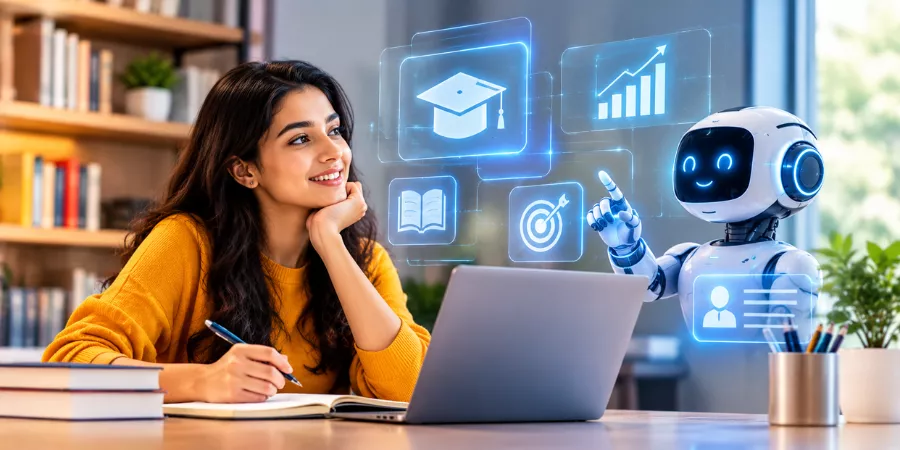
Yes. AI can adapt content to each learner’s level and pace, keep practice steady through reminders and instant feedback, and turn every interaction into data teachers and managers can act on. It works best as a support for good teaching, not a replacement for it.
How Does AI Make Learning More Personal?
A classroom of thirty students has thirty different starting points. One teacher cannot tailor every explanation to every child, but software can come close.
Adaptive learning platforms watch how a learner answers. Get three fractions questions right in a row and the system moves you on. Stumble twice and it offers a simpler explanation, a worked example or a short video before trying again. The learner never has to put a hand up and admit confusion.
AI tutors add another layer. A student can ask “why does this formula work?” at 11 pm and get an answer pitched at their level, in plain language, and ask again if it still doesn’t click. Language apps now adjust vocabulary to what you keep forgetting. Workplace tools recommend courses based on your role and your gaps.
Personalisation also means choice of format. Some people learn from reading, others from listening or practising. AI can offer the same idea in several forms and learn which one sticks.
How Does AI Make Learning More Consistent?
Most people don’t fail to learn because they lack ability. They fail because they stop. Life gets busy, a week slips, and the habit dies.
AI helps in three practical ways:
- Nudges at the right time. Reminders can be timed to when a learner is most likely to study, not sent at a fixed hour for everyone.
- Spaced repetition. Algorithms schedule reviews just before you would forget something, which is far more effective than cramming.
- Instant feedback. Waiting days for corrected homework breaks the learning loop. When feedback arrives in seconds, mistakes get fixed while the topic is still fresh.
Consistency also applies to quality. Two teachers may explain the same topic very differently, and one may be having a bad day. AI delivers a reliable baseline explanation every time, which teachers can then build on.
How Does AI Make Learning Measurable?
This is where AI changes the most. Traditionally, progress was measured in occasional tests: a term exam, an annual review. By then it is often too late to help.
AI tracks learning continuously. It can show:
- Which concepts a learner has mastered and which are shaky
- How long they take on different question types
- Where the whole class is struggling, so a teacher can revisit the topic tomorrow
- Whether a training programme is changing on-the-job performance, not just completion rates
For schools, that means earlier intervention. For businesses, it means finally linking training spend to results. Instead of “85% completed the course,” you can say “error rates in this process dropped after the module.”
Good measurement still needs good questions. A dashboard full of numbers is useless if it measures the wrong things, such as clicks or time on screen rather than understanding.
What are the Limits and Risks of AI in Learning?
- AI tools can produce confident but wrong explanations. Learners, especially beginners, may not spot the error. Content should be checked, and tools grounded in approved material are safer.
- Over-reliance. If a tool does the thinking, the learner doesn’t build the skill. The best systems prompt students to attempt answers first and give hints rather than solutions.
- Learning data is personal, and often belongs to children. Schools and employers should know what is collected, where it is stored and who can see it.
- Bias and access. Algorithms trained on narrow data can serve some groups worse than others, and learners without reliable devices or internet are left behind.
- The human element. Motivation, encouragement and mentoring still come mostly from people. AI can free teachers from marking and admin so they have more time for exactly that.
How Can Schools and Businesses Get Started?
- Pick one clear problem. Slow feedback, uneven training quality and weak progress tracking are all good starting points.
- Start small. Pilot with one class, team or subject before rolling out widely.
- Choose measures that matter. Decide upfront what success looks like: test scores, time to competence, retention or job performance.
- Keep humans in the loop. Teachers and trainers should review insights and make the final calls.
- Check privacy and accuracy. Ask vendors how data is handled and how content is verified.
- Review and adjust. Use the data to improve, then repeat.
Conclusion
AI can make learning more personal by adapting to each learner, more consistent by keeping practice regular and feedback quick, and more measurable by showing progress as it happens. Its value depends on how thoughtfully it is used: accurate content, clear goals, protected data and teachers who stay at the centre. Used that way, it gives every learner something they have rarely had at scale, which is attention to their own needs.