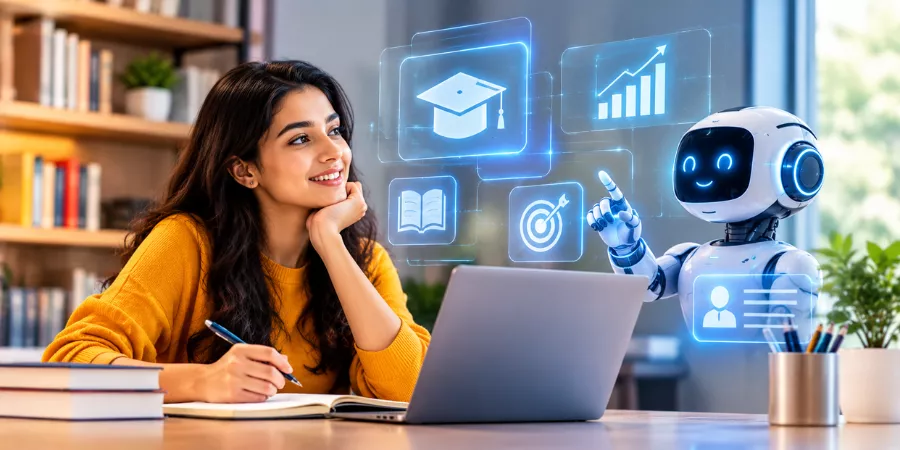


Education should teach people how to think with information, not how to store it. That means critical evaluation, reasoning, communication, collaboration and the ability to keep learning. Facts still matter, but as raw material for judgment rather than as the finish line.
Why Does Free Information Change What Education is For?
For most of history, schools existed partly because knowledge was scarce. Books were rare, experts were far away, and a teacher was often the only route to what you needed to know.
That scarcity is gone. A phone can now answer questions about chemistry, law, cooking or coding in seconds, and AI tools can explain them in plain language. If the purpose of school was to hand over information, that job has largely been done by technology.
But access is not understanding. Having a library in your pocket does not make you well read, just as owning a gym membership does not make you fit. The real gap has moved from “can you find it?” to “can you make sense of it and use it well?”
Do Facts Still Matter?
Yes, and this is where many “just Google it” arguments go wrong.
You cannot think critically about a topic you know nothing about. Reading a news story about inflation, a medical report or a contract requires background knowledge to even understand the words, let alone question them. Experts spot errors quickly because they hold a large store of knowledge in memory.
Basic fluency also frees up attention. A child who has to look up every multiplication fact cannot focus on solving the actual problem. A professional who must search for core terms cannot hold a conversation.
So, the question is not whether to teach knowledge, but which knowledge, and why. A strong foundation of core concepts in each field is what makes everything else learnable.
What Skills Should Education Prioritise?
- Evaluating information: When anyone can publish anything, the most valuable habit is asking: who made this, what do they want, what is the evidence, and what is missing? Learners should practise checking sources, spotting weak statistics and noticing when something is designed to provoke rather than inform. This now includes judging AI-generated answers, which can sound certain while being wrong.
- Reasoning and problem solving: Logic, maths and scientific thinking teach people to build arguments, test ideas and tolerate uncertainty. These skills transfer across subjects and careers far better than memorised content.
- Clear communication: Knowing something is only useful if you can explain it, persuade others or write a message that gets understood. Writing is also thinking made visible. Students who cannot write clearly usually cannot think clearly yet.
- Collaboration and empathy: Real problems are solved by teams. Listening, disagreeing respectfully and working with people who see things differently are skills most workplaces now rank among the hardest to find.
- Learning how to learn: Careers now span several changes in technology. People who know how to set goals, practise deliberately, seek feedback and recover from failure can pick up whatever comes next. This habit matters more than any single syllabus.
- Creativity and curiosity: Search engines answer questions but cannot decide which questions are worth asking. Curiosity, original thinking and the willingness to make something new remain stubbornly human strengths.
- Ethics and responsibility: Powerful tools raise hard questions about privacy, fairness, truth and consequences. Students need practice weighing right and wrong, not only what is possible.
How Should Classrooms Change?
The shift is less about new subjects and more about new ways of working.
- Assess understanding, not recall. If a test can be passed by searching, it is testing the wrong thing. Open-ended tasks, oral explanations and project work reveal real comprehension.
- Teach with real problems. Projects that need research, judgment and teamwork build several skills at once.
- Use technology deliberately. Let students use AI and search, but require them to check, question and improve what comes back.
- Reward process and mistakes. Learners who fear errors avoid hard problems. Reflection on what went wrong builds resilience.
- Value the teacher’s new role. Less lecturing, more coaching, questioning and feedback.
What are the Risks of Getting this Wrong?
Two opposite mistakes are common. One is to keep teaching as if nothing changed, drilling facts that a device can supply. The other is to abandon knowledge entirely in favour of vague “skills,” leaving students unable to think about anything because they know nothing.
There is also an equity risk. Children with educated parents, good devices and quiet homes learn to use information tools well on their own. Those without may simply consume whatever the algorithm serves. Schools are often the one place where critical thinking is taught deliberately, which makes this work more important, not less.
Conclusion
When information is free, the scarce resources become attention, judgment and understanding. Education should build a solid base of knowledge, then focus on teaching people to evaluate, reason, communicate, collaborate and keep learning. The goal is no longer to produce people who know a lot, but people who can work out what is true, what matters and what to do next.