

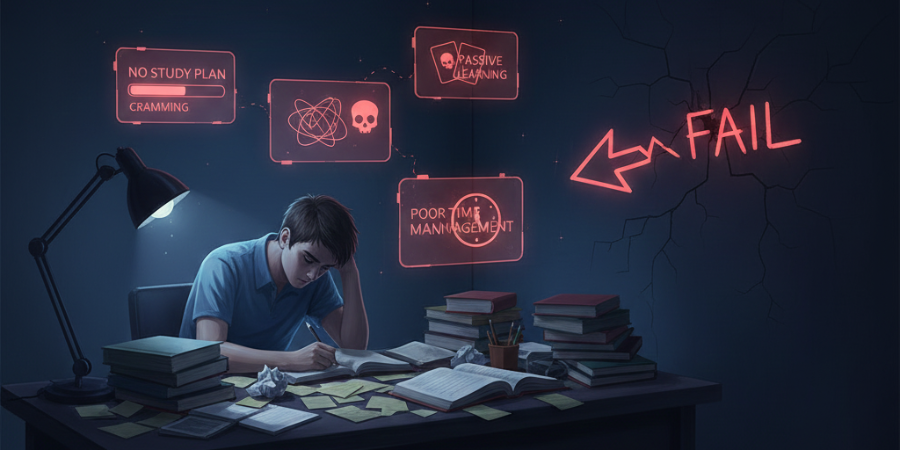
Students spend hundreds of hours revising for exams yet consistently make the same avoidable mistakes that undermine all that effort, transforming potentially excellent performances into disappointing results. The gap between time invested and marks earned often reflects not insufficient revision but rather ineffective revision approaches that create illusions of learning while building no genuine retention or understanding. Research shows that 73% of students rely primarily on passive rereading despite cognitive science proving this among the least effective study methods available. The frustration of forgetting material you swear you revised thoroughly days before exams stems from predictable revision errors that students repeat because nobody explicitly taught them what effective revision actually involves. Understanding these critical mistakes and their corrections transforms revision from time-consuming ritual into genuinely productive preparation that produces results matching your effort investment.
Starting Revision Too Late
The single most damaging revision mistake involves waiting until two weeks before exams to begin serious review, creating time pressure that forces superficial coverage instead of deep consolidation. This compressed timeline guarantees that you’ll attempt cramming rather than actual revision, and cramming produces short-term familiarity that evaporates within days rather than durable understanding that lasts through exams and beyond.
Effective revision requires beginning at minimum one month before major exams, ideally six to eight weeks for comprehensive coverage allowing multiple review cycles. The first review pass reminds you of material studied earlier, the second strengthens connections and fills gaps, and third or fourth passes create genuine mastery that withstands exam pressure. Single-pass revision from last-minute starts never builds this depth regardless of hours invested during that compressed period.
Many students confuse finishing syllabus with being ready for revision. They complete the last chapter three days before exams and believe revision can now begin, not recognizing that solid revision requires having encountered material previously with sufficient time between exposures for spaced repetition effects to work. The content studied three days ago hasn’t had time to partially forget, which paradoxically is necessary for effective retrieval practice that strengthens memory.
Starting early also provides buffer for discovering weak areas that need substantial remediation rather than quick review. The topic you thought you understood often reveals gaps when you attempt practice questions, and addressing these gaps requires time that late revision starts don’t provide. You end up either ignoring weak areas hoping they won’t appear on exams or attempting superficial review that doesn’t actually address the underlying conceptual confusion.
Passive Rereading Instead of Active Retrieval
The default revision strategy for most students involves rereading notes and textbooks repeatedly, often highlighted in multiple colors with the conviction that familiar-looking material means learned material. This creates the fluency illusion where repeated exposure makes information feel known without actually making it retrievable under exam conditions when you don’t have your notes available as memory prompts.
Active recall represents the gold standard of revision techniques yet remains underutilized because it feels harder and less comfortable than rereading. Close your notes completely and write everything you remember about a topic on blank paper. This forced retrieval from memory rather than recognition of familiar text builds the neural pathways that exams actually test. The struggle to remember is precisely what strengthens memory, while the ease of rereading highlighted notes creates false confidence that crumbles when you face exam questions.
Practice testing through previous exam papers, sample questions, or self-generated questions transforms passive review into active preparation. Each practice question you attempt strengthens memory more than rereading the same content five times. Yet students consistently prioritize reading over testing because testing reveals gaps that feel uncomfortable while reading creates pleasant familiarity.
Make flashcards for key concepts, definitions, formulas, and relationships, then test yourself repeatedly rather than just reading through the cards. Digital spaced repetition apps like Anki automate optimal review timing, presenting cards more frequently when you struggle and less often when you demonstrate mastery. This systematic approach to active recall dramatically outperforms intuitive study methods that feel productive but build minimal retention.
Studying Without Testing Understanding
Many students revise entire syllabi without ever attempting actual exam-style questions under realistic conditions, then discover during exams that knowing material doesn’t equal applying it under time pressure. The mathematics you understand perfectly while referring to worked examples becomes inaccessible when facing blank paper and ticking clock. The essay topic you feel confident about becomes jumbled confusion when you must organize coherent arguments in 45 minutes.
Integrate practice questions throughout revision rather than treating them as final-week activities. After revising each topic, immediately attempt five to ten questions of varying difficulty to verify that you can apply concepts, not just recognize them. This early testing reveals whether your revision is actually working while you still have time to adjust approach rather than discovering problems during exams when it’s too late.
Take full-length practice exams under strict exam conditions at least three times during final two weeks before major tests. Use actual time limits, eliminate all resources and distractions, and force yourself to work through the complete paper even when stuck or tired. These simulations build stamina, reveal time management issues, and expose gaps that isolated topic revision misses.
The marks you score on practice papers predict exam performance far more accurately than your subjective feelings about preparation adequacy. Students consistently overestimate readiness based on note familiarity while practice testing provides objective reality checks forcing course corrections before actual exams.
Reviewing Everything Equally
Revising the entire syllabus with equal attention regardless of importance, difficulty, or your current mastery wastes enormous time on material you already know well while shortchanging topics that actually need work. The comfortable topics feel productive to review because you experience success and fluency, but this represents time poorly invested when weaker areas go unaddressed.
Create a prioritization matrix categorizing topics by both importance and your mastery level. High-importance weak topics demand the most revision time. High-importance strong topics need maintenance review but not intensive study. Low-importance weak topics deserve strategic neglect when time is limited, accepting that you might sacrifice these marks to secure more valuable ones elsewhere. Low-importance strong topics need minimal review or none.
Focus on previous exam papers revealing which topics appear frequently versus rarely. The chapter appearing in every exam for five years straight demands more attention than the one appearing once. Many students spend equal time on all chapters without recognizing that examiners consistently emphasize specific areas that your revision should prioritize accordingly.
Weak areas often get neglected because they’re frustrating and uncomfortable to study. The mathematics topic you don’t understand feels painful to review while the history topic you’ve mastered feels satisfying, creating perverse incentive to over-prepare strengths while avoiding weaknesses. Forcing yourself to invest disproportionate time in genuinely weak areas despite the discomfort separates revision that improves performance from revision that merely reinforces what you already know.
Solo Revision Without External Input
Studying exclusively alone prevents you from discovering that you’ve misunderstood concepts, memorized incorrect information, or developed poor exam techniques that others would immediately notice and correct. Your mistakes become invisible because you have no reference point revealing them.
Study groups provide multiple benefits when structured properly. Explaining concepts to peers solidifies your understanding while exposing gaps in your knowledge that private study hides. Hearing how others approach problems reveals alternative methods and perspectives that enhance your own understanding. The social accountability prevents procrastination that solo study struggles with when motivation wavers.
However, study groups easily devolve into social sessions that waste time without producing learning. Establish clear rules including specific topics to cover each session, time limits preventing sprawl, and expectations that everyone comes prepared. Sessions should involve teaching each other, solving problems collaboratively, and testing one another rather than just sitting together while studying independently.
Seek teacher feedback on practice answers showing your work to someone who can identify errors you wouldn’t recognize. Many teachers willingly review practice papers or answer questions during office hours, yet students rarely utilize this resource until it’s too late. Early feedback reveals whether your answer writing style matches examiner expectations while you still have time to adjust.
Neglecting Physical and Mental Health
The revision period often involves deteriorating sleep, poor nutrition, eliminated exercise, and mounting stress that students accept as necessary sacrifices when these factors directly undermine the cognitive performance that revision aims to improve. Your brain is an organ requiring proper care to function optimally, and depriving it of sleep, nutrition, movement, and stress management sabotages retention and recall regardless of study hours invested.
Protect sleep religiously during revision periods despite temptation to sacrifice rest for additional study hours. Sleep consolidates memories and clears mental clutter, meaning the hours spent sleeping enhance next day’s study effectiveness more than using those hours for exhausted late-night review. Students consistently overestimate the value of sleep-deprived study while underestimating the cognitive costs that poor sleep imposes.
Maintain regular meals and basic nutritional adequacy even when time pressure tempts skipping meals or surviving on coffee and processed snacks. Stable blood sugar supports sustained focus while wild fluctuations create energy crashes that waste afternoon hours in unproductive fog. The 20 minutes spent preparing decent meals returns through hours of better mental performance.
Strategic breaks aren’t time wasted but rather essential recovery periods that sustained focus requires. The Pomodoro Technique of 25-minute work intervals followed by five-minute breaks maintains intensity that hour-long sessions without breaks cannot sustain as attention inevitably drifts. Use breaks for genuine rest including physical movement rather than switching to social media that provides no cognitive recovery.
Revision effectiveness multiplies when you address these systematic errors, transforming the same time investment into dramatically better outcomes through eliminating counterproductive habits that most students never question.