
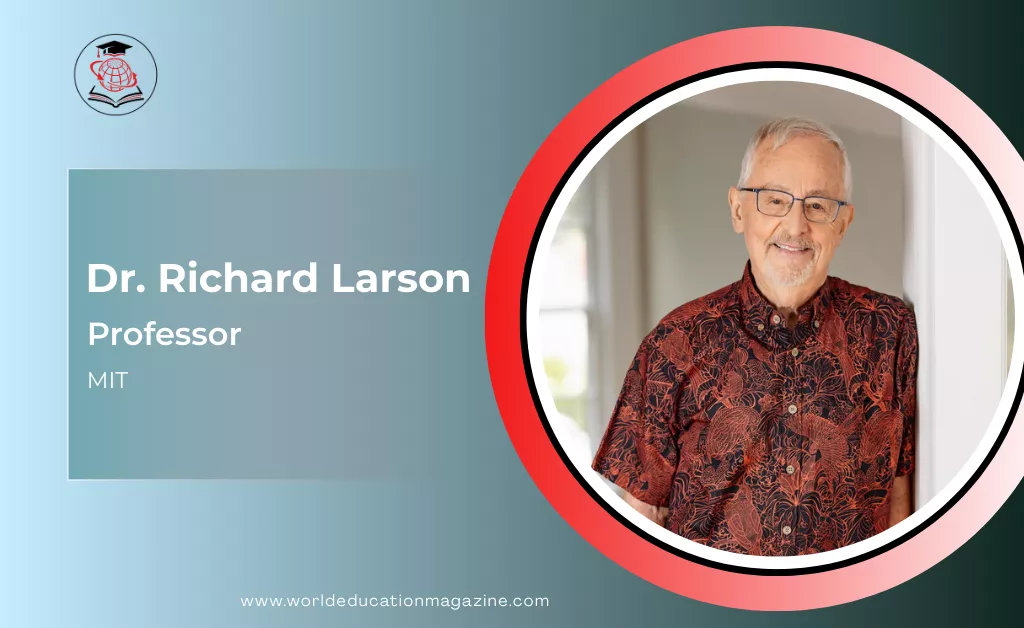
Imagine a crowded intersection where impatient vehicles wait hostage to a stubbornly unchanging traffic light. Now picture someone reprogramming that signal to become intuitive, responsive, and smart. This perfectly captures what visionary leaders do in education: transforming outdated, rigid structures into dynamic pathways of opportunity. Dr. Richard Larson embodies this transformational approach, bridging urban systems and global learning to dismantle barriers that once confined world-class education to privileged corridors.
From Queuing Theory to Educational Equity
Known affectionately as “Dr. Queue,”Dr. Richard Larson began his career studying the mathematics of waiting lines. This seemingly narrow focus evolved into groundbreaking innovations in global learning that have reshaped how millions access quality education worldwide.
His expertise in emergency response modeling provided unexpected insights into educational access. “When I was able to distribute my work on Emergency Response Modelling via this technology, that opened my eyes wide to the wonderful ways in which the internet provides equity of access to all, rich and poor, urban, suburban and rural,” Dr. Larson explains.
The emergence of the Internet in the 1990s facilitated this transformation, allowing instant global communication. Dr. Larson recognized that the same technology enabling emergency response coordination could democratize access to world-class educational materials, regardless of students’ geographic or economic circumstances.
Pioneering Digital Learning Before It Was Mainstream
Dr. Larson’s work with the Singapore MIT Alliance in the 1990s represented groundbreaking experimentation in distance learning. This digital program opened his eyes to possibilities that seemed revolutionary at the time but have become educational norms today.
“The Singapore MIT Alliance opened my eyes widely to the possibility of teaching remotely anywhere on Planet Earth, 24/7. That was ground-breaking,” he recalls. This early experience positioned him decades ahead of the massive digital transformation that COVID-19 would later force upon educational institutions worldwide.
His forward-thinking approach demonstrated that geographic distance need not determine educational opportunity. Students in Singapore could access MIT faculty expertise in real-time, foreshadowing today’s global online learning ecosystem.
MIT BLOSSOMS: Blended Learning for Global Classrooms
One of Dr. Larson’s most impactful contributions is MIT BLOSSOMS (Blended Learning Open Source Science or Math Studies), a program delivering world-class educational content to diverse classrooms worldwide. Unlike purely digital platforms, BLOSSOMS emphasizes blended learning that combines video modules with in-classroom interaction.
“The lessons are delivered to a classroom with its usual students and the regular in-class teacher. This teacher facilitates the class interaction as they respond to and discuss what they have just seen on a BLOSSOMS video,” Dr. Larson explains.
The program’s greatest challenge has been finding motivated, qualified in-class teachers at the delivery end. This requirement underscores Dr. Larson’s conviction that technology should enhance rather than replace human teaching. The model recognizes that effective learning requires both high-quality content and skilled facilitation, combining digital innovation with irreplaceable human connection.
BLOSSOMS has reached thousands of classrooms globally, providing students in under-resourced schools access to educational materials comparable to those available at elite institutions. This democratization of educational content represents practical realization of Dr. Larson’s equity vision.
Intuition Meets Data: The Bayesian Approach
In an era obsessed with data-driven decision-making, Dr. Larson offers nuanced perspective on balancing quantitative analysis with human intuition. “I’m a Bayesian in thought and behavior, not a statistician who listens only to numbers. I map intuition into Bayesian thinking. So, to me, intuition is just as important (perhaps more so) than pure statistics,” he asserts.
This philosophical stance recognizes that statistical numbers often emerge from flawed processes, producing misleading interpretations. “Good intuition can pick this up right away,” Dr. Larson notes, highlighting how experienced judgment complements analytical rigor.
His Bayesian approach proves particularly valuable in educational contexts where human factors, cultural nuances, and unmeasurable variables significantly impact outcomes. Pure data analysis might suggest one intervention, while intuition informed by decades of experience recognizes crucial contextual factors that numbers alone cannot capture.
From Dumb Traffic Lights to Smart Educational Systems
Dr. Larson’s recent focus on traffic light optimization illustrates how systems thinking applies across domains. “There is no excuse for Dumb Traffic Lights,” he declares, referring to fixed-cycle signals that ignore real-time traffic conditions.
His calculations demonstrate that modest investments making traffic lights responsive to actual conditions would generate returns through reduced delays and fuel consumption. This same logic applies to educational systems: rigid, unresponsive structures waste human potential just as dumb traffic lights waste time and resources.
The parallel extends further. Just as smart traffic lights adapt to changing conditions, effective educational systems must respond dynamically to student needs, learning styles, and evolving workforce demands. Dr. Larson’s systems thinking reveals underlying patterns connecting seemingly disparate challenges.
Creating Order from Educational Chaos
Dr. Larson’s career demonstrates repeatedly how systems-based approaches bring clarity to chaos. As a doctoral student working with the New York City Police Department, he applied queuing theory to their newly implemented 911 Emergency Call System, where callers experienced delays exceeding 25 minutes.
“I helped bring Queueing Theory to work on the problem and delays plummeted,” he recalls. This success story illustrates how mathematical modeling combined with practical insight can solve real-world problems affecting millions of people.
The same principles apply to educational challenges. Whether addressing classroom overcrowding, optimizing resource allocation, or designing effective distance learning systems, systems thinking provides frameworks for understanding complex interactions and identifying leverage points for meaningful improvement.
Human Intelligence Over Artificial Intelligence
While artificial intelligence dominates contemporary educational technology discussions, Dr. Larson maintains refreshing perspective. “I’m not an AI expert. And I prefer ‘HI’ to AI, where HI is Human Intelligence,” he states plainly.
This preference reflects his career-long commitment to human-centered design. Technology should amplify human capabilities rather than replace them. “Ethical considerations should accompany AI just as it does in routine teaching by humans,” he asserts, emphasizing that technological advancement must align with educational values prioritizing student welfare.
Dr. Larson’s stance resonates particularly as educational institutions rush to integrate AI tools without fully considering implications for teaching relationships, learning authenticity, and educational equity. His reminder to prioritize human intelligence offers important counterbalance to technological determinism.
Balancing Campus and Digital Learning Experiences
As universities grapple with balancing traditional campus experiences against growing demand for digital learning, Dr. Larson sees convergence rather than conflict. “In my view, the two options are now merged. Many in-class lectures and problem sessions are now routinely broadcast via the Internet or television to students at great distances from the classroom. I do not see any conflict here,” he explains.
This perspective, informed by decades pioneering distance learning, suggests that binary thinking about physical versus digital education misses the point. Modern educational ecosystems successfully integrate both modalities, offering flexibility while preserving benefits of in-person interaction when valuable.
The key lies in thoughtful design that leverages each format’s strengths. Lectures might broadcast globally while small-group discussions happen face-to-face. Laboratory work requires physical presence while theoretical components work well remotely. Dr. Larson’s integrated approach recognizes educational experiences exist on continuums rather than as either-or propositions.
Model Thinking for Global Challenges
Looking toward the future, Dr. Larson advocates for widespread adoption of “model thinking,” a concept explored in his recent book “MODEL THINKING For Everyday Life” (INFORMS, 2023). The title’s double meaning captures his vision: model as exemplary, something worth emulating, and model as conceptual or mathematical framework.
“Educate the public about Model Thinking and many global challenges can be solved or at least improved,” Dr. Larson asserts. This democratization of systems thinking represents natural extension of his educational equity work. If more people understand how to structure complex problems, identify patterns, and test solutions systematically, humanity’s collective capacity for addressing challenges expands dramatically.
Model thinking provides cognitive tools for navigating increasingly complex world. Whether addressing climate change, pandemic response, or educational reform, systematic approaches that combine rigorous analysis with human judgment offer pathways through complexity toward practical solutions.
Structuring Chaos, Creating Opportunity
Dr. Richard Larson’s career demonstrates that meaningful innovation springs from curiosity, practical insight, and human-centered values. Whether decoding waiting line intricacies or revolutionizing global education access, he consistently seeks clarity amid complexity, transforming chaos into coherent, impactful systems.
His profound belief in merging intuition with data underscores a timeless truth: genuine progress requires both heart and science. As educational institutions navigate technological disruption, changing student needs, and persistent equity gaps, Dr. Larson’s integrated approach offers valuable guidance.
By championing accessible world-class education, advocating for systems thinking in everyday life, and insisting that human intelligence remains central to technological advancement, Dr. Larson invites us all to imagine and help create a world where opportunity is universal, intelligence is deeply human, and learning knows no boundaries. His legacy extends far beyond academic contributions, touching countless lives through educational access that might otherwise have remained confined to privileged corridors.