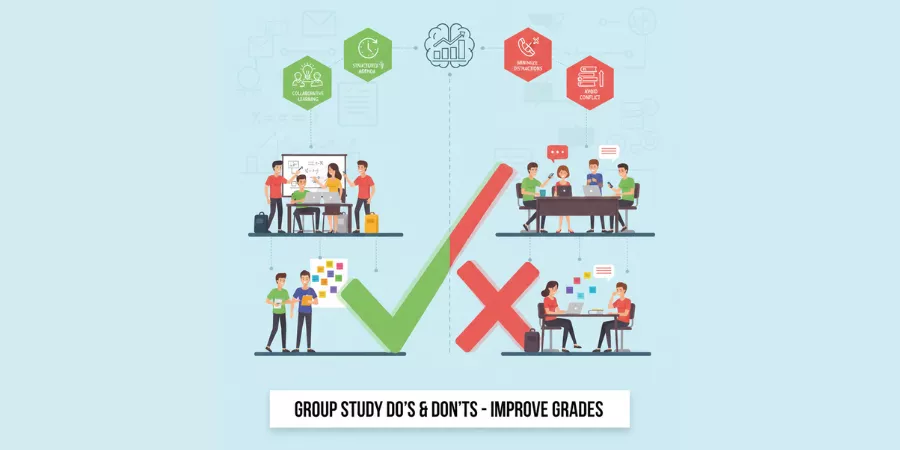
Your study group has devolved into a social hour again. You’ve covered maybe 20% of the planned material, half the members haven’t prepared, and you’re wondering why you didn’t just study alone. Sound familiar? Research from the American Association of Colleges and Universities reveals that collaborative assignments are among their eleven high-impact educational practices, yet many students report frustration with unproductive group sessions.
Here’s what you need to know: A 2024 study published in the Journal of Statistics Education found that students working in properly structured groups of three, four, and five significantly outperformed those studying individually or in pairs. However, the University of Iowa’s Learning Center emphasizes that simply joining a study group won’t automatically lead to better grades the difference between productive collaboration and wasted time comes down to following specific, research-backed practices. Let’s explore the essential do’s and don’ts that transform mediocre study groups into powerful learning accelerators.
DO: Keep Your Group Size Between 3-5 Members
Princeton researcher Patrick Laughlin conducted a landmark study with 760 students, comparing individual performance against groups of two, three, four, and five. The results were striking: groups of two performed no better than individuals working alone, but groups of three, four, and five all equally outperformed them.
A 2021 Frontiers in Education study confirmed that four-member groups represent the optimal configuration for peer learning. Students in four-member groups showed greater learning improvements than those in smaller or larger groups. The sweet spot exists for specific reasons: groups of three or more provide enough diverse perspectives to challenge thinking patterns, while keeping below six members prevents the formation of sub-groups that fragment collaboration.
Research from Building Thinking Classrooms in Mathematics educator Peter Liljedahl specifically recommends three-person groups, arguing that pairs lack sufficient variety in perspectives while groups of four and above tend to splinter into competing factions.
The practical takeaway? Start with three to four members and add a fifth only if you need particularly diverse expertise for complex subjects. Never exceed six members unless you’re conducting specialized review sessions with assigned roles.
DON’T: Meet Without a Clear Agenda
Study groups fail most often when members arrive without preparation or purpose. The University of Toledo’s research on successful collaboration emphasizes treating study sessions like business meetings New York Times contributor Adam Bryant interviewed over 500 chief executives who uniformly stressed that effective meetings require clear agendas set in advance.
A 2025 study from Teachfloor on collaborative learning found that groups setting clear objectives from the outset aligned members better and maintained focus throughout sessions. Without structure, sessions devolve into unfocused discussions where dominant personalities monopolize time while quieter members disengage.
Stanford’s College Puzzle research recommends planning your study methods before each session. For a chemistry exam, your agenda might specify: review chapters 7-8 notes (20 minutes), practice balancing equations (30 minutes), quiz each other on reaction mechanisms (25 minutes), identify remaining weak areas (15 minutes).
Compare notes from lectures, create practice questions for each other, review for upcoming tests with specific topics assigned, or lead structured discussions where each member teaches a concept. The format should match your subject math groups focus on solving problems together, while sociology groups benefit from discussing theoretical frameworks and debating interpretations.
DO: Use Retrieval Practice, Not Passive Review
Dr. Keith Sawyer’s research on study group effectiveness revealed something fascinating: students learning at deeper levels looked up and engaged conversationally with group members instead of reading off pages. Making this conversational connection through active recall represents the key factor in why study groups work.
STATMed Learning’s evidence-based recommendations emphasize retrieval practice as the most effective group strategy. This involves actively recalling information you’re trying to learn rather than passively re-reading notes. The more you practice retrieval, the stronger information becomes encoded in long-term memory.
Here’s how to implement this in your group:
Question-and-Answer Rounds: Each member prepares 3-5 questions with answers on assigned material. Take turns posing questions while others formulate answers without looking at notes. The questioner uses their notes only for verification.
Timed Mini-Lectures: Write topics on slips of paper, have members randomly select one, then deliver a 5-minute explanation using a whiteboard. This combines retrieval practice with dual coding (explaining while drawing diagrams), which dramatically improves retention.
Practice Test Creation: Before exams, assign each member to create 10 practice questions that mimic the test format. Complete these collaboratively, discussing why certain answers are correct.
The University of Iowa emphasizes that avoiding passive rereading or review is critical. Work together to create flashcards, flowcharts, concept maps, or study guides, but always test yourselves rather than just reviewing materials.
DON’T: Allow Unequal Participation
Participation rates tell the story of group dysfunction. Research shows that in three-person groups, average speaking time per person reaches 33%. In eight-person groups, it plummets to just 12%. Even in optimally-sized groups, passive members and dominant personalities derail learning.
Education Corner’s research on effective study groups stresses that every member must actively participate. The best strategy? Assign specific roles that rotate each session: facilitator (keeps discussion on track), scribe (documents key points), time manager (monitors agenda), and presenter (explains complex concepts to the group).
Assigning topics to individual members for research and summary ensures everyone contributes meaningfully. One member might explain photosynthesis, another covers cellular respiration, a third handles the Krebs cycle. Teaching others solidifies your own understanding when you can explain a concept clearly to peers, you’ve truly mastered it.
Address unequal participation directly. If someone consistently arrives unprepared, have a private conversation about commitment levels. Stanford research suggests compromising to form stronger bonds, but groups must maintain academic standards. Members who repeatedly fail to prepare should be politely asked to study independently.
DO: Schedule Sessions Strategically
Cognitive research reveals that optimal attention spans in group settings peak at 25-30 minutes. Smaller groups maintain focus more effectively than larger ones during these windows. Structure your sessions around this biological reality rather than fighting it.
The most effective groups meet for 90-120 minutes maximum, incorporating short breaks every 30 minutes. Meeting frequency matters too once or twice weekly provides enough continuity to maintain momentum without overwhelming busy schedules. According to a 2025 CollegeXpress study on online study groups, consistent meeting times that accommodate everyone’s availability dramatically improve attendance and engagement.
Don’t schedule study groups too close to exams. Groups work best for building understanding throughout the semester, not cramming the night before. A British Journal of Educational Psychology study from January 2024 found that students who engaged in spaced practice with their groups over weeks showed 12% higher test scores than those who only met for last-minute review.
| Session Timing | Duration | Best For | Effectiveness |
|---|---|---|---|
| Weekly check-ins | 60-90 min | Ongoing learning | High retention |
| Pre-exam intensive | 2-3 hours | Final review | Medium (only if built on prior work) |
| Daily quick groups | 30-45 min | Homework collaboration | Good for maintaining momentum |
| Semester-long rotation | 90 min weekly | Comprehensive mastery | Highest overall impact |
DON’T: Confuse Socializing With Studying
This represents the most common study group pitfall. What starts as a focused session on organic chemistry reactions degrades into discussing weekend plans, comparing professors, or scrolling through social media together. Providence College’s Academic Services warns that attracting students interested in studying not socializing requires intentional group formation.
Set ground rules immediately. Phones go on silent or in bags. Social chat happens during designated 5-minute breaks only. If someone consistently derails conversations, the facilitator redirects respectfully: “Great story, but let’s table that for our break and get back to enzyme kinetics.”
Choose your location strategically. Stanford research emphasizes that productive spaces are crucial for well-functioning groups. Libraries, student lounges, and quiet study rooms help channel productive attitudes. Dorm rooms or homes work only if truly quiet and distraction-free. Avoid coffee shops unless your group has exceptional focus ambient noise and foot traffic sabotage concentration.
Be honest about motivations. If you’re joining a group hoping to earn an A while others just want to pass, frustration is inevitable. Discuss goals explicitly during your first meeting. Groups work best when members share similar academic ambitions and commitment levels.
DO: Create Accountability Systems That Work
Groups lacking accountability mechanisms consistently underperform. The University of Toledo’s collaboration research found that successful groups establish clear expectations and consequences from day one.
Start each session by reviewing what members agreed to prepare. If someone arrives unprepared repeatedly, the group should address this directly. Use shared documents Google Docs or Notion where members log what they covered during each session and what they’ll prepare for next time.
Assign preparation responsibilities explicitly. Instead of “everyone review chapter 5,” specify: “Jordan explains glycolysis pathways, Sam creates 10 practice problems on ATP production, Taylor summarizes the chapter’s main concepts in a one-page outline.” Specific assignments eliminate ambiguity and ensure no one arrives empty-handed.
Consider creating group chats for quick questions between sessions, but establish boundaries. The chat should support learning, not become a 24/7 homework helpline that creates dependency rather than understanding.
Your group’s success hinges on following these evidence-based practices: maintain the proven 3-5 member size, structure sessions with clear agendas, prioritize active retrieval over passive review, ensure equal participation, schedule strategically around attention spans, maintain study focus over socializing, and implement accountability systems. Groups that ignore these principles waste time, while those that embrace them create powerful learning environments that boost grades and deepen understanding. Start your next session by auditing your current practices against this framework, then make one improvement at a time until your group operates at peak effectiveness.