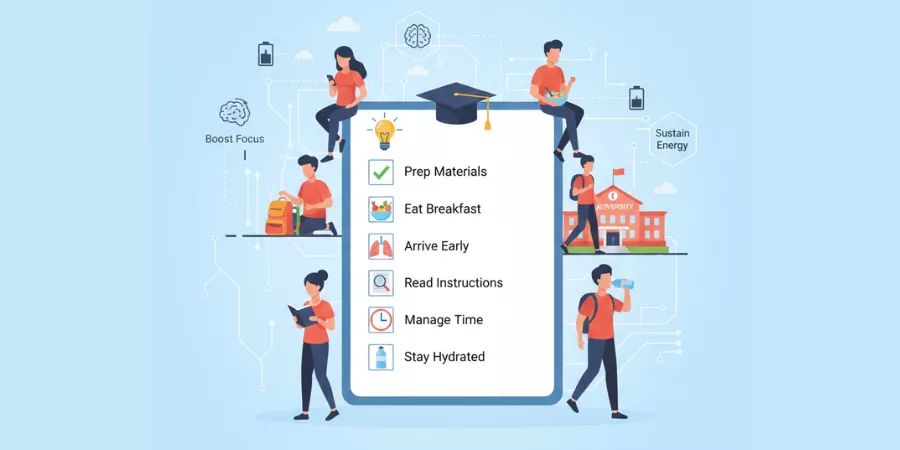
You’ve spent weeks preparing, your notes are organized, and you understand the material. Then exam day arrives, and everything falls apart because you forgot your calculator, arrived frazzled after oversleeping, or crashed from skipping breakfast. Sound familiar? A Higher Education Policy Institute study found that students using structured preparation reported 30% lower stress levels and achieved significantly higher scores than those who didn’t plan systematically.
Here’s what research tells us: your performance on exam day depends less on last-minute cramming than on executing a proven checklist that primes your brain and body for peak performance. A 2024 study from MIT demonstrated that sleep quality and consistency for the month before an exam correlated with better grades, while the single night before showed no correlation with test performance. Let’s explore the evidence-based checklist that transforms exam day from anxious chaos into confident execution.
The Night Before: Sleep Trumps Last-Minute Studying
Harvard research confirms what your instincts already tell you: students who sleep 7-9 hours score higher on memory-based tasks than those who sacrifice sleep for extra study time. But here’s the surprising part Stanford’s Lifestyle Medicine research on MIT students revealed that consistency of sleep patterns may have greater impact on GPA than sleep duration itself.
This means your routine for the week before matters enormously. Students who maintained consistent wake-up times within 30 minutes daily even on weekends outperformed those with irregular schedules, even when the irregular sleepers logged more total hours.
Cornell University’s Learning Strategies Center emphasizes that ten hours of studying spread over five days beats ten hours crammed into two days. Your brain consolidates information during sleep, transforming short-term memories into long-term retrieval pathways. Pulling an all-nighter doesn’t just make you tired it actively prevents the neural consolidation that makes recall possible during your exam.
Your Night-Before Protocol:
Set a firm study cutoff time at least 90 minutes before bed. After this point, no new material. Your brain needs time to wind down, and the American Academy of Sleep Medicine research shows that dimming lights and disconnecting from screens signals your body that sleep approaches. Organize all materials calculators, pencils, admission tickets, photo ID, approved notes if allowed and place them by your door. This simple step eliminates morning panic and decision fatigue when your willpower is lowest.
Morning Fuel: The Breakfast Research You Need to Know
The American Academy of Pediatrics research is unequivocal: students who eat breakfast demonstrate better energy and concentration during exams than those who skip it. But not all breakfasts are equal. Skyline Academic’s analysis of straight-A student routines found that protein-rich breakfasts providing 20-30 grams of protein maintain steady energy and sharpen focus throughout morning exams.
A study published in research examining 1,259 college students over eleven years found that significantly higher percentages of students who ate breakfast passed their Biology exams compared to those who skipped the meal. The mechanism? Your brain’s cerebral metabolic rate for glucose utilization runs approximately twice as high during learning tasks as during rest. After an overnight fast, glycogen stores deplete breakfast replenishes the glucose your brain demands for optimal function.
| Optimal Breakfast Components | Amount | Why It Matters |
|---|---|---|
| Protein (eggs, Greek yogurt, cottage cheese) | 20-30g | Sustains energy, prevents mid-exam crashes |
| Complex carbohydrates (oatmeal, whole grain toast) | 1-2 servings | Provides steady glucose for brain function |
| Hydration (water) | 16-20 oz | Prevents dehydration-related concentration loss |
| Avoid: excess sugar, heavy fats | – | Causes energy spikes/crashes, sluggish feeling |
Research on breakfast effects demonstrates that dehydration alone reduces concentration by 10%. Your body loses water during sleep that first glass of water rehydrates your system and prevents the headaches and fatigue that sabotage performance.
Timing Your Arrival: The Goldilocks Window
University of North Carolina’s Learning Center recommends arriving early enough to settle in without rushing, but not so early that anxiety balloons while waiting. The optimal window? Fifteen to twenty minutes before start time. This gives you time to locate your seat, organize materials, visit the restroom, and take several deep breaths while your nervous system stabilizes.
Arriving too late triggers panic that floods your system with cortisol and adrenaline, impairing the prefrontal cortex functions you need for complex problem-solving. Arriving too early creates a dangerous window for anxiety to compound you’ll likely encounter unprepared classmates expressing negativity or discussing material in ways that trigger self-doubt.
The University of Colorado’s test anxiety research specifically warns against talking with fellow students about exam material immediately before entering. If this situation has historically increased your anxiety, avoid it entirely. Find a quiet spot away from crowds, listen to calming music, or practice the breathing techniques you’ve prepared.
Managing Test Anxiety: Techniques That Actually Work
A 2024 Teachers College study surveyed nearly 3,000 students at a large public university about anxiety symptoms. The research, published in Professor Ben Lovett’s book “Overcoming Test Anxiety,” revealed that test anxiety commonly results in procrastination and avoidant behaviors that become self-fulfilling prophecies of poor performance. Students with high test anxiety avoid study materials, perform poorly, then blame anxiety when the anxiety influenced their preparation choices, not just their test-taking ability.
Third-grade students who practiced diaphragmatic breathing for five weeks significantly reduced self-reported test anxiety according to a compelling 2010 study. The technique works by interrupting the fight-or-flight response that anxiety triggers. Here’s the protocol: breathe deeply into your diaphragm for a count of four, hold for four counts, exhale for four counts, hold empty for four counts. Repeat this cycle five times when you feel panic rising.
Cirkled In’s Test Anxiety Toolkit recommends arriving early, reading instructions thoroughly, and implementing strategic time management. Start with questions you know confidently this creates positive momentum and allows time for the adrenaline surge to subside before tackling difficult items. Research on medical students conducted in 2024-2025 found that emotion regulation and adaptive coping mechanisms significantly enhanced academic performance under test conditions.
Your Physical State: The Variables You Control
Springer Publishing’s exam preparation research emphasizes that you’re asking your body and brain for peak performance you must provide optimal conditions. Beyond sleep and nutrition, this means strategic choices about stimulants. While moderate caffeine can enhance alertness, excessive amounts amplify anxiety symptoms that you’re trying to manage. If you typically consume caffeine, maintain your normal intake rather than dramatically increasing or eliminating it on exam day.
Successful morning routines of straight-A students documented by Skyline Academic include brief physical activity. Just 5-10 minutes of movement jumping jacks, a short walk, or light stretching increases blood flow to your brain and helps process nervous energy. The University of North Carolina’s test day protocol specifically recommends quick exercises before exams to help with attention and overall cognition.
Dress in comfortable layers. Testing rooms vary wildly in temperature, and being too hot or cold creates a distraction you can’t eliminate. Bring a light jacket you can remove if needed.
During the Exam: Strategic Execution Protocols
The University of Pittsburgh’s seven-day test prep plan emphasizes that exam day execution follows a strategic sequence. Read all instructions carefully before starting rushing this step causes avoidable errors. A study on students’ study activities before and after exam deadlines found that regular behavioral engagement throughout the semester predicted performance far better than last-minute cramming.
Time management during the test matters enormously. Calculate how many minutes you can allocate to each section based on point values. UNC’s Learning Center recommends completing sections in order of their overall value to earn maximum possible points if time runs short. For example, if an essay worth 60% of points requires detailed analysis, allocate 60% of your time there rather than getting stuck perfecting multiple-choice questions worth 10%.
Mark difficult questions and continue moving. Your brain continues processing in the background questions that seemed impossible initially often become clear when you revisit them after answering others. Research shows that information in other exam questions sometimes provides clues for items you found challenging earlier.
Post-Exam: Protecting Your Performance
Once you complete the exam, resist the temptation to immediately discuss it with classmates. This practice triggers unnecessary anxiety about questions you may have answered differently and cannot change. The University of Colorado’s anxiety management research found that post-exam rumination significantly increases stress without benefiting future performance.
If you have multiple exams during the week, treat the recovery period strategically. Brief celebration is appropriate, but don’t let relief derail preparation for upcoming tests. Students from a 2025 study on STEM courses who maintained regular engagement after midterm exams obtained higher course grades than those who relaxed standards post-exam.
Execute this evidence-based checklist systematically: prioritize consistent sleep over last-minute studying, fuel your brain with a protein-rich breakfast, arrive in the fifteen-minute sweet spot before start time, deploy breathing techniques when anxiety strikes, optimize your physical state through hydration and light movement, implement strategic time management during the exam, and resist post-exam rumination. These aren’t just helpful suggestions they’re research-backed protocols that give you every possible advantage when performance matters most.