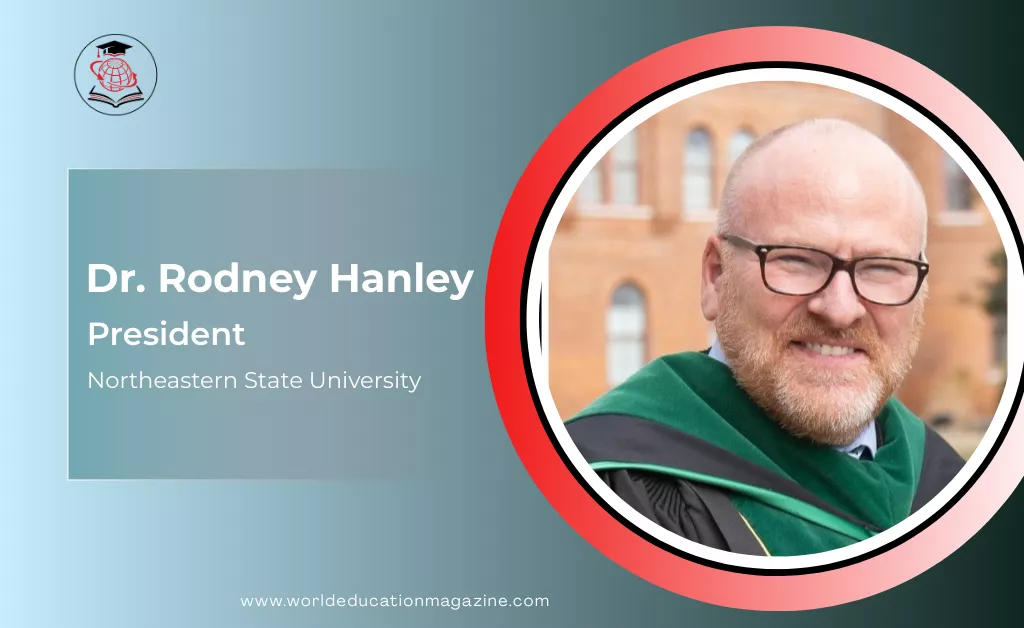
Innovation drives progress, especially in education where it challenges traditions, redefines norms, and creates previously unimaginable possibilities. For Dr. Rodney Hanley, President of Northeastern State University, innovation represents more than a strategic initiative. It embodies a profound commitment to reshaping education for a rapidly changing world while maintaining unwavering focus on the people it serves.
From First-Generation Student to Educational Champion
Dr. Rodney Hanley’s journey toward educational leadership began in central Illinois, where neither privilege nor certainty defined his path. His father worked in a factory, his mother dedicated herself to homemaking, and the prospect of higher education seemed ambitious, if not daunting.
“I’m a first-generation college student,” Dr. Hanley shares. “When I graduated from high school, I knew I wanted to go to college, but I didn’t know what I wanted to study. Like many first-generation college students, it took me a while to figure out my career.”
This uncertainty became a stepping stone rather than a roadblock. With guidance from enthusiastic professors who recognized his potential, Dr. Hanley not only completed his undergraduate degree but pursued advanced graduate studies. Each academic milestone clarified his vision: leveraging his first-generation experience to uplift others from similar backgrounds.
“One of the common themes throughout my career has been helping students like me,” Dr. Hanley explains. “These students often have different needs, but their pathway is no less important than anyone else’s. That’s been a driving force for me.”
This passion for serving underserved populations became his professional cornerstone. Throughout his career, Dr. Hanley deliberately chose institutions serving financially disadvantaged students, shaping policies and programs that make higher education accessible, equitable, and impactful. Today at Northeastern State University (NSU), he continues honoring this mission, ensuring the institution remains a beacon of opportunity for students from all backgrounds.
Leading Through Collaboration and Adaptability
Leadership in higher education demands delicate balance between vision, collaboration, and navigating uncharted territory. For Dr. Hanley, visionary leadership transcends decision-making to foster environments where innovation and inclusivity thrive together.
“A visionary leader does a number of different things, the first of which is to rely on people around them to help examine the ecosystem they’re in,” Dr. Hanley explains. He emphasizes understanding each university’s unique context, recognizing how challenges and opportunities interconnect within complex institutional systems.
Higher education encompasses financial management, academic excellence, research initiatives, and community engagement. “It’s impossible for one person to have their arms around the entire set of issues,” Dr. Hanley admits. “That’s why it’s essential for a leader to have the humility to listen to team members and rely on others in their areas of expertise.”
Central to his leadership philosophy is looking beyond immediate horizons to identify emerging trends and challenges. Universities cannot afford relying solely on past traditions or customary practices. Instead, they must consciously adapt to new realities to remain relevant and impactful.
“There’s danger for a university if it relies on past traditions and responds to new challenges in an unexamined way,” Dr. Hanley warns. “On balance, I have consciously led my institutions to be adaptable, ensuring they are well-positioned to face the future.”
At NSU, this adaptability manifests through strong relationships Dr. Hanley cultivates among administration, faculty, and staff. These connections form the foundation for meaningful collaboration and drive institutional success.
Pioneering Programs That Expand Access
Under Dr. Hanley’s leadership, NSU has launched groundbreaking programs addressing diverse student needs and community demands. These initiatives reflect his dedication to innovation, inclusivity, and adaptability.
Direct Admit Initiative
The Direct Admit program represents one of NSU’s most transformative efforts. Through partnerships with local high schools, NSU provides automatic admission to students graduating in good standing. This initiative eliminates college access barriers and encourages high school students to envision higher education futures early in their academic journeys.
Adult Continuing Learner Outreach
Recognizing shifting demographics, Dr. Hanley prioritized outreach to adult continuing learners, describing them as the largest pool of potential students in the United States. These individuals may have started college years ago but left for various reasons without completing degrees.
“They might be ready to come back to the university and finish their degree to get that promotion or move up in their career,” Dr. Hanley explains. NSU’s innovative programs offer tailored support helping these learners resume education and achieve career goals, addressing workforce development needs while expanding educational access.
International Enrollment Expansion
Dr. Hanley spearheaded efforts expanding NSU’s global reach, capitalizing on strong worldwide demand for American education. Over the past year, these initiatives yielded remarkable results with international enrollment increasing by 164%.
“The idea of an education from an American university is highly desirable around the world,” he notes, reflecting growing interest from students abroad seeking quality American higher education experiences.
Workforce-Aligned Academic Programs
Dr. Hanley’s commitment to educational relevance extends to academic programs themselves. He consistently challenges faculty ensuring offerings align with workforce needs and modern career demands. “We’re adding new academic programs focused on workforce readiness in the state of Oklahoma,” he shares.
This alignment enhances graduate employability while strengthening the university’s ties to regional economies. A major project currently underway is the Oklahoma College of Optometry, which Dr. Hanley believes will set national benchmarks. “I believe this is going to be one of the finest optometry facilities anywhere in the United States when it’s completed,” he says enthusiastically.
These initiatives have produced measurable results. Over the past year, NSU achieved 4% overall enrollment increase, demonstrating the university’s ability to adapt and thrive under Dr. Hanley’s leadership.
Embracing Technology While Preserving Human Connection
Technology has become a transformative force reshaping knowledge delivery and consumption. For Dr. Hanley, staying ahead of technological advancements is essential to maintaining NSU’s relevance and impact in an increasingly digital world.
“When I was an undergraduate, the internet wasn’t a thing,” Dr. Hanley reflects. “Now, not only is the internet completely woven into our education system and culture, but artificial intelligence is emerging as the leading edge.”
Recognizing this shift, Dr. Hanley prioritized positioning NSU at the forefront of technological integration, particularly artificial intelligence (AI) integration into academic offerings. “AI can quickly analyze extremely large data sets within seconds and give a summary of the data,” he explains. This capability opens doors to asking and answering intellectual questions previously beyond reach.
Beyond AI, Dr. Hanley views technology as a means to foster innovation across all university facets. From hybrid learning models to tools supporting faculty curriculum development, NSU embraces a future where technology enhances rather than replaces education’s human element.
However, Dr. Hanley acknowledges inherent risks. “There’s always a risk to being on the leading edge of integration of technology and education,” he says. “But with a thoughtful approach and appropriate safeguards in place, I’m convinced that NSU will thrive going into the future.”
Addressing Higher Education’s Critical Challenges
“There’s no lack of challenges that higher education faces,” Dr. Hanley states candidly. He highlights funding constraints, aging infrastructure, employee compensation, and deferred maintenance. However, one pressing concern stands out: disparity in access and success for students from disadvantaged backgrounds.
“We have so many people in society who are left behind when it comes to higher education,” he observes. “These are typically first-generation or financially disadvantaged students from rural areas. It is so difficult for these students to navigate higher education and persist all the way to graduation.”
Dr. Hanley views addressing these inequities as a critical university mission. At NSU, he champions programs and policies ensuring students from underserved communities receive necessary support for success. “Going to college and getting a degree will change a life,” he asserts. “But it’s more than that—it changes the trajectory of entire subsequent generations.”
Despite navigating these complex issues, Dr. Hanley remains optimistic about higher education’s power to drive societal progress. For him, today’s challenges represent calls to action, reminders of universities’ vital roles shaping not just individual lives but futures of communities and nations.
Charting NSU’s Strategic Future
As NSU continues evolving under Dr. Hanley’s leadership, the institution’s future follows a clear, ambitious roadmap. Over the next three years, strategic priorities focus on expanding university reach, refining academic offerings, and deepening community impact.
At the heart of these goals lies the mission to broaden NSU’s enrollment base. Dr. Hanley envisions reaching more students from diverse backgrounds, including those from rural communities, transfer students, international learners, and adult continuing learners.
“We are working on expanding our enrollment base at the institution through outreach to these groups,” he explains. By building robust pipelines bringing students from these demographics to NSU, the university grows its student body while strengthening its role as an inclusive, accessible institution.
Student engagement represents another cornerstone of Dr. Hanley’s vision. He believes fostering vibrant campus life is critical to attracting and retaining students. “We’re interested in looking at student activities to reinforce what draws students here,” he says. Whether through clubs, athletics, or other extracurricular initiatives, NSU aims creating environments where students are academically engaged and socially fulfilled.
NSU’s multi-campus structure across Tahlequah, Muskogee, and Broken Arrow, Oklahoma presents unique opportunities tailoring offerings to specific community needs. Dr. Hanley commits ensuring all students receive necessary support and resources. “We’re doing everything in our power to accommodate student needs and respond to workforce needs of those communities,” he emphasizes.
Education as Generational Transformation
Dr. Rodney Hanley’s leadership at Northeastern State University demonstrates that higher education can simultaneously pursue excellence and equity. His journey from first-generation college student to university president informs every decision, ensuring NSU remains accessible to students who need higher education most while maintaining academic rigor and innovation.
“Everyone deserves the opportunity to craft their own future,” Dr. Hanley asserts. This philosophy shapes every institutional initiative, from expanding access through Direct Admit programs to integrating cutting-edge technologies that prepare students for evolving workforce demands.
As higher education faces unprecedented challenges including changing student preferences, technological disruption, and funding constraints, Dr. Hanley’s model offers a compelling path forward. By balancing innovation with tradition, technology with human connection, and institutional growth with individual student success, he proves that universities can thrive while fulfilling their foundational mission: transforming lives and strengthening communities for generations to come.